
H
Great company come out gave a good price and done the job straight away highly reccomend chris great guy
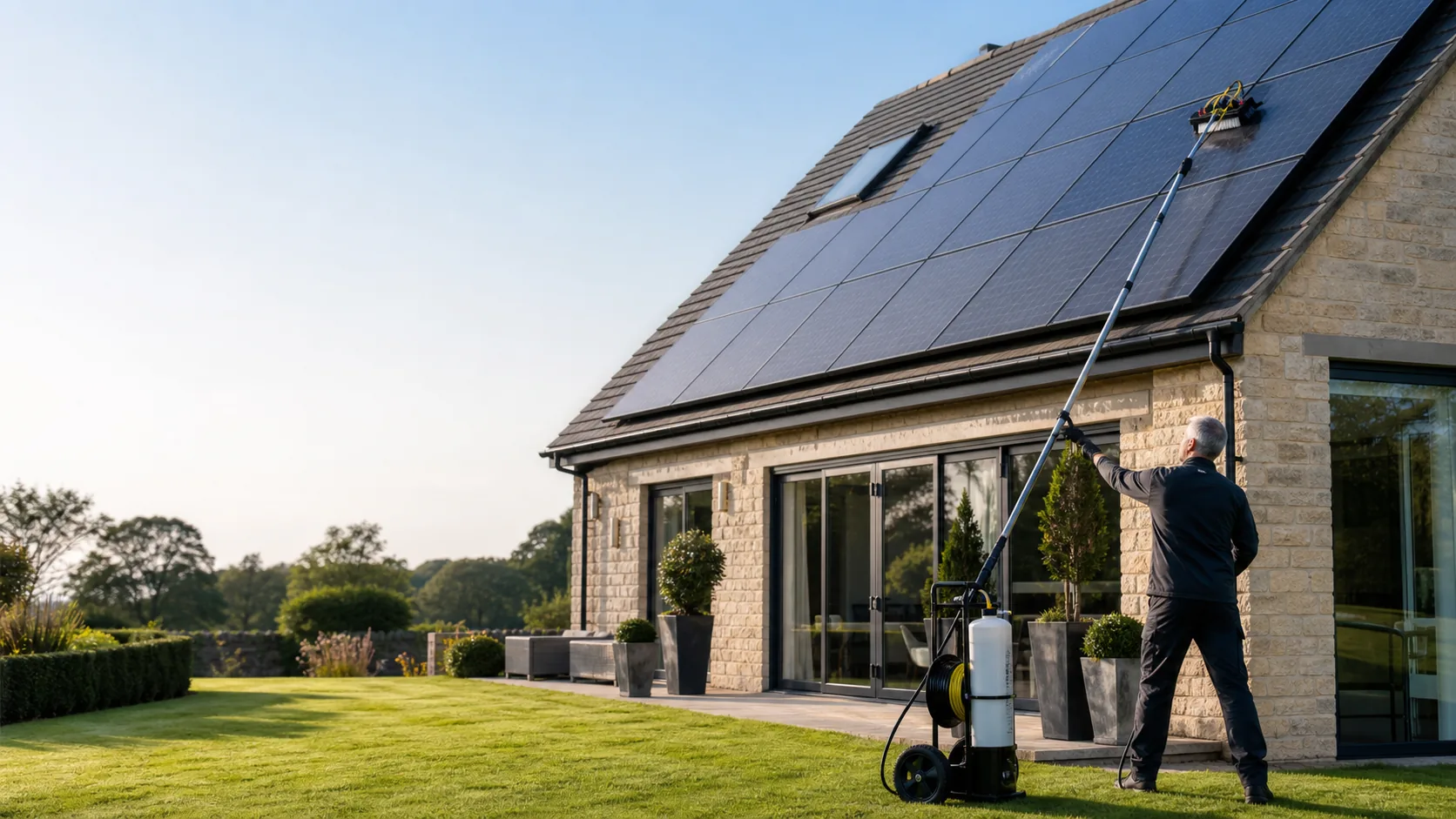
Solar panel cleaning in Cardiff is not really about appearance. It is about the film of road dust, pollen, moss spores and bird mess that builds along the bottom edge of every panel and shades the cells underneath. We clean panels with purified water and a soft brush from the ground, no detergent, no pressure washer and nobody walking your roof.

Step 1 of 3 · no obligation, reply the same day
The same care and clear communication, whether it is a single path or a whole house.
Cells inside a panel are wired in series, and panels are wired in series into a string. Current through a series chain is set by its weakest link, so heavy shade on a few cells drags down everything wired with them. Bypass diodes limit the damage by switching the shaded section out, but that section then produces nothing at all. It is why a scatter of pigeon droppings costs you more than an even veil of dust across the whole array. Soiling losses on an uncleaned UK roof are commonly put at around 2 to 5 percent, with badly fouled arrays losing more than that. Those are typical figures, not a promise. Your own number depends on pitch, aspect and what is landing on the glass.
The worst of it collects in one place. The aluminium frame stands slightly proud of the glass, so every panel has a small lip along its lower edge. Rain carries silt down the glass and the lip holds it. After a few winters that becomes a dark band a couple of centimetres deep across the bottom of each panel, and moss and lichen root into it. On a portrait mounted panel that band sits over the full bottom row of cells, which is why generation starts dropping long before the array looks dirty from the drive.
Rain does not clean solar panels in South Wales. It arrives with whatever is in the air and leaves it behind as it dries. Add a shallow pitch, common on newer estates and on garage and extension roofs, and water sits instead of sheeting off. Below about 15 degrees the self cleaning effect is close to useless. Then there is what surrounds the roof. Tree cover in Penylan, Cyncoed, Lisvane and parts of Whitchurch drops sap and leaf litter straight onto arrays. Roofs near the bay in Grangetown and Splott take gull and pigeon traffic plus salt off the channel. Anything on a main route into the city, Newport Road, Cowbridge Road, the A470 corridor, collects brake dust and diesel soot, and that is greasy. It will not rinse off with a hose.
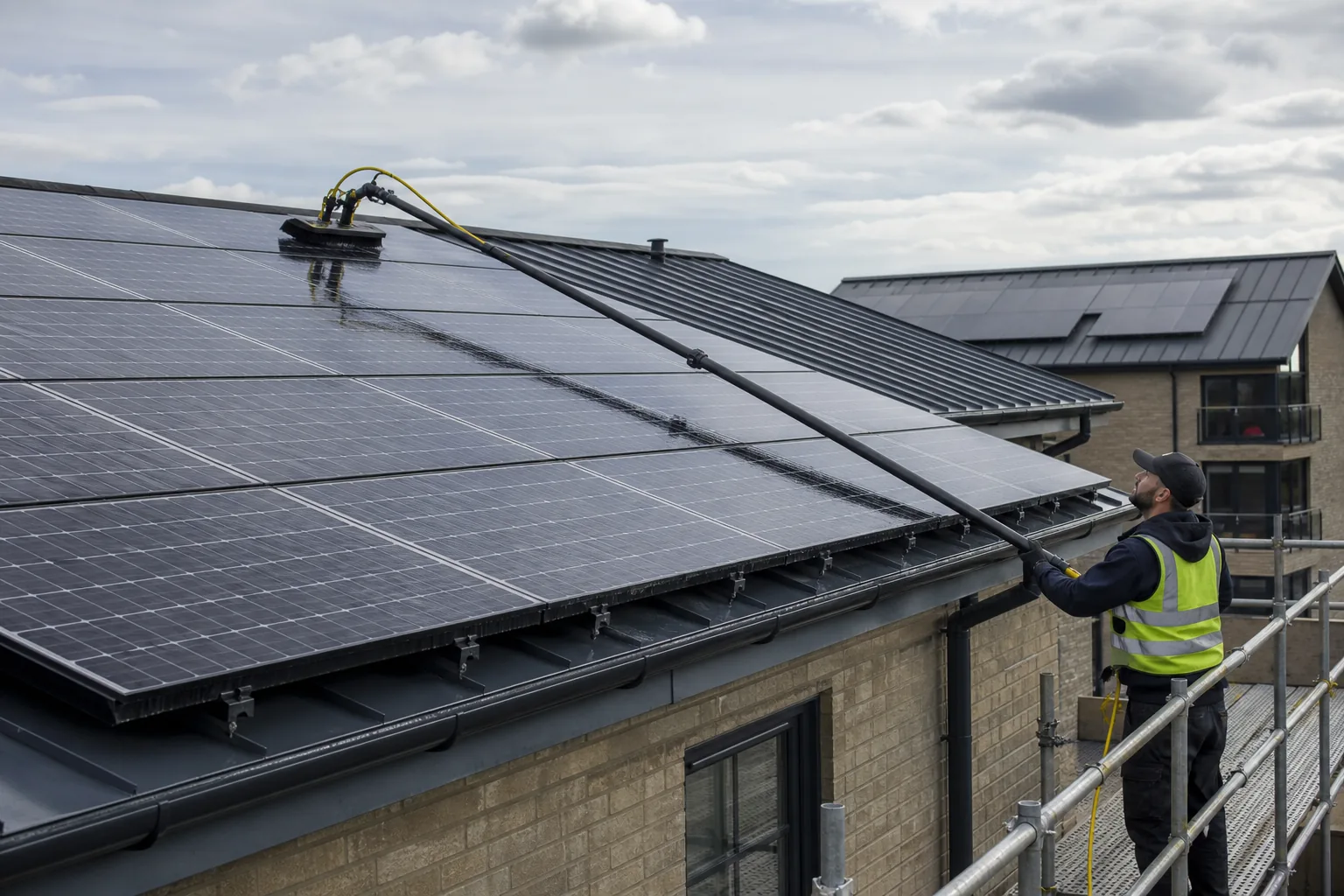
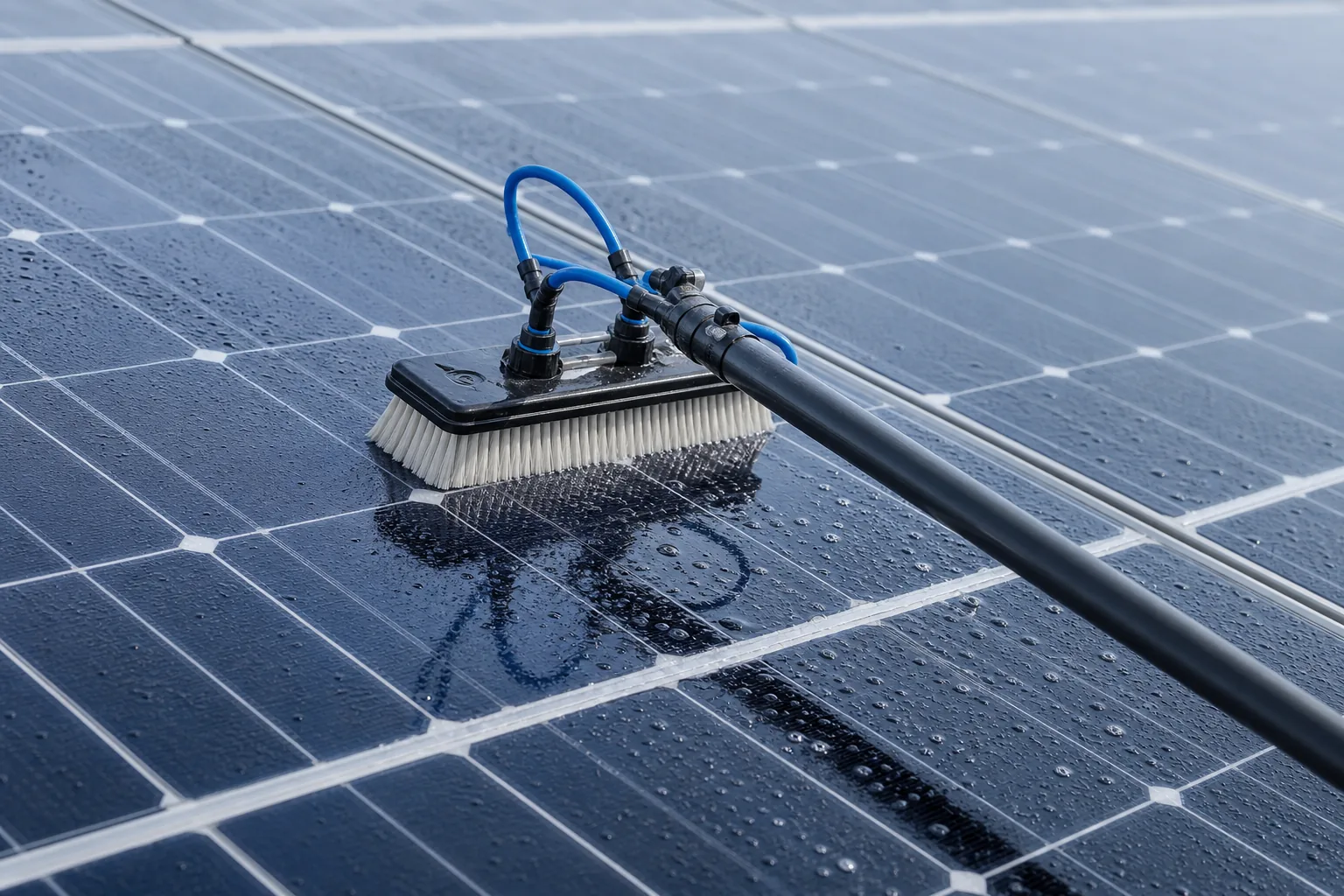
We run deionised water up a telescopic pole to a soft bristle brush head. The water passes through resin until a meter reads close to zero dissolved solids, so it dries off the glass without leaving the mineral spotting you get from a garden hose. The brush lifts the film, the pure water floats it away, and the panel dries on its own. Nothing is buffed dry and nothing abrasive goes near the anti-reflective coating.
The pole reaches a standard two-storey Cardiff roof from the driveway or the garden, so on most jobs nobody sets foot on the tiles. That matters more than it sounds. Walking a pitched roof to reach an array cracks tiles, disturbs bedding mortar and puts weight on glass that was never made to carry it. Rear arrays on the Victorian terraces in Roath and Canton are the usual test, because everything has to come through a side lane or a narrow back garden. Where an array genuinely cannot be worked from the ground, we say so at the quote rather than improvising on the day.
Detergent is the common mistake. It leaves a residue and that residue is tacky. Within weeks the panel has picked up more dust than it carried before the clean, and the new film is bonded rather than loose. Some products also attack the sealant round the frame and the coating on the glass. Worth checking your own installation paperwork too, because manufacturers often exclude chemical cleaners from warranty cover. That is a poor trade for a job pure water does better anyway.
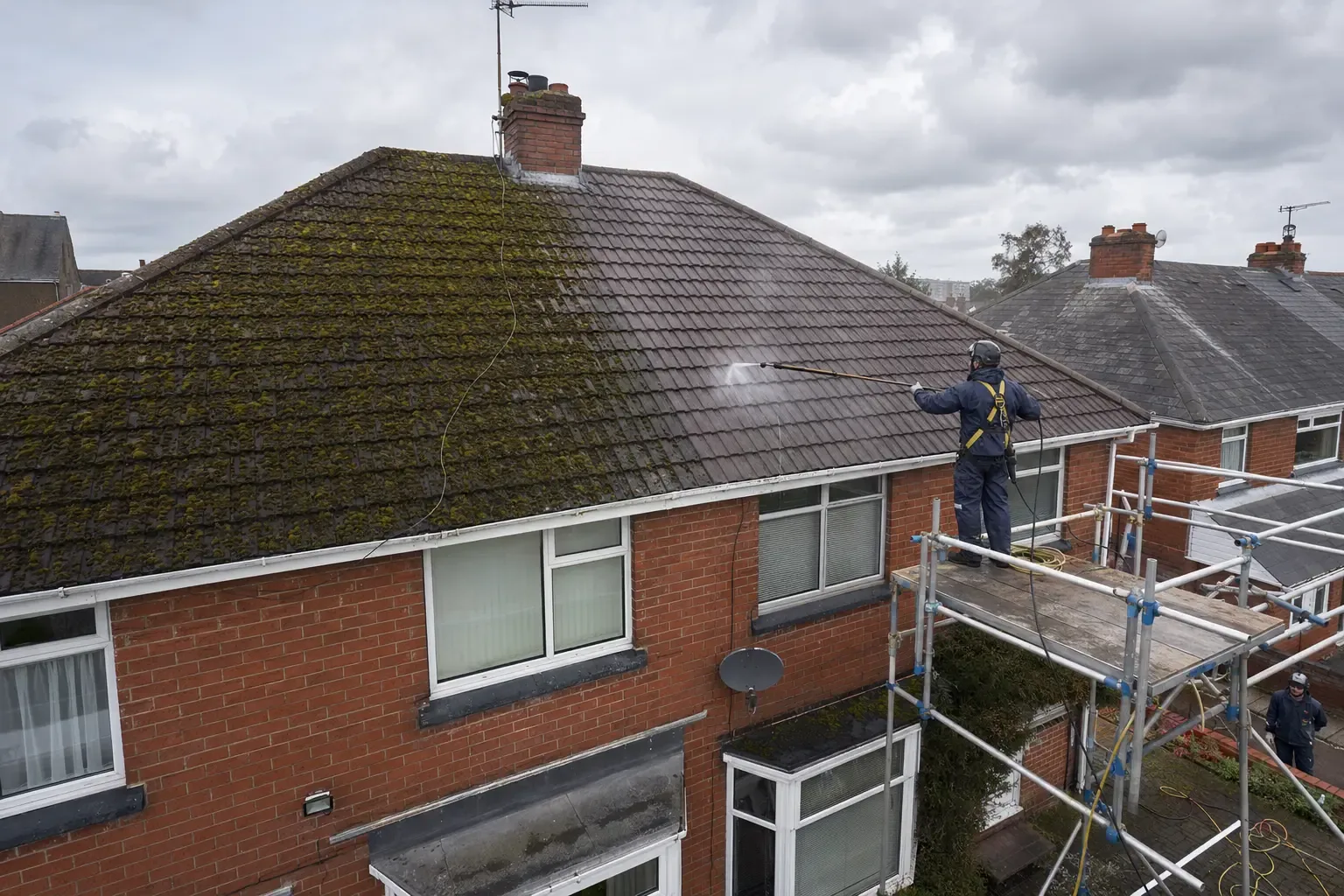
A pressure washer is worse. The seal between glass, frame and backsheet is built to shed rain, not to hold out a jet running well over 100 bar. Force water past it and you are into the cells, the wiring and the junction box on the underside, and that failure usually surfaces months later as corrosion or a dead string rather than as an obvious leak. Cold water on glass that has been baking all afternoon adds thermal shock on top. Micro-cracks from either do not announce themselves. You find them in your generation figures.
Pigeons and gulls nest in the gap between the panels and the tiles. It is warm, sheltered and out of reach, and once a pair settles they come back every year. What you get is a steady run of droppings down the glass, nesting material washing into the gutter and valley, mites in the roof space and, at its worst, debris packed deep enough to hold water against the tiles.
Cleaning the glass deals with the symptom for a season. We clear nesting debris out of the gap while we are working the array and send you photographs of what is up there, but if birds are back in every spring the real fix is proofing. Know what good proofing looks like before you buy it: mesh clipped to the perimeter of the panel frames, nothing drilled into the panels, nothing drilled into the roof covering. Anyone reaching for a drill is putting your panel warranty and your weatherproofing at risk. Where fouling keeps returning, cleaning on its own is money spent twice.
Once a year suits most Cardiff homes, and late spring is the sensible slot. The pollen has dropped, winter moss growth is at its heaviest, and your strongest generating months are still ahead of you.
The honest way to set your own interval is to watch the numbers. Record your generation on a clear day now and compare it with a similar clear day after a clean. If the gap is small, stretch the interval. If your inverter app shows one string trailing the other week after week, look into it when it appears, because something is usually shading it.
We price per panel with a minimum charge for the visit, which is how most of the trade quotes this work. As a rough guide, a domestic array of 8 to 14 panels in Cardiff usually lands somewhere around £60 to £150 in total. Treat that as indicative rather than a quote. What moves the number is the panel count, whether the array is on a bungalow or a two-storey roof, how reachable it is from the ground, whether lichen or bird fouling needs repeat passes, and how far out of Cardiff you are. Putting gutter clearing or a conservatory roof on the same visit costs less than two separate trips.
Send us your postcode, the number of panels and roughly how old the installation is, and we will give you a price before we come out. We cover Cardiff and South Wales, including Roath, Penylan, Cyncoed, Lisvane, Llanishen, Whitchurch, Rhiwbina, Radyr, Llandaff, Canton, Pontcanna, Grangetown, Splott, Rumney, Llanrumney and Cathays, plus Barry, Newport and the surrounding area. Call 07576 128903 or email Liamdunn2406@outlook.com. We answer seven days a week, 7:00 to 21:30, we have been cleaning exteriors across the city since 2019, and our Google rating is 5.0 from five reviews.
Solar panel cleaning is normally priced per panel with a minimum charge for the visit. As a rough guide, a domestic array of 8 to 14 panels in Cardiff usually falls somewhere around £60 to £150 in total. That is guidance rather than a quote. What moves the number is the panel count, the height and pitch of the roof, how easily the array is reached from the ground, whether lichen or bird fouling needs extra passes, and whether you add gutter clearing or a conservatory roof to the same visit. Send us your postcode and panel count and we will price it properly before we travel.
A standard array of ten to sixteen panels on a two-storey house takes roughly 45 to 90 minutes, including setting up the pole and filter and packing away afterwards. A first clean on an array that has never been touched takes longer, because the lichen band along the bottom edge of each panel has to come off with repeated gentle passes rather than force. Larger arrays, awkward rear access and commercial or barn roofs are quoted by the job. We give you a realistic time window when we book rather than a vague all day slot.
Not the way we do it. Clean water and a soft brush are the standard method for panel glass, and nothing abrasive or chemical goes near the anti-reflective coating or the frame seals. The two things that genuinely cause damage are pressure washers, which can drive water past the seal into the cells and the junction box, and detergents, which manufacturers often exclude from warranty cover. We use neither. Nobody stands or kneels on the panels, and on most Cardiff houses nobody goes on the roof at all, so your tiles and mortar are left alone. If you still have your installation paperwork, read the cleaning section.
It depends on how dirty the panels were. Soiling losses on an uncleaned UK roof are commonly put at around 2 to 5 percent, and badly fouled arrays, particularly ones with bird mess or a thick moss band across the bottom edge, can be losing more than that. Those are typical figures, not a guarantee, and anyone promising a fixed percentage before seeing the roof is guessing. The way to learn your own number is to record generation on a clear day before the clean and compare it with a similar clear day afterwards.
Once a year is right for most homes with an open roof and a normal pitch. Twice a year makes sense if you are under trees, on a pitch below about 15 degrees where rain never properly sheets off, near a main road or a building site, or dealing with regular gull and pigeon fouling. Late spring is the usual choice, after the pollen has dropped and ahead of the best generating months. If your inverter app shows one string consistently underperforming, have it looked at then rather than waiting for the annual visit.
No, provided we can reach the garden or driveway on the side the panels face and get to an outside tap. Nobody needs to come inside the house at any point. If the array is at the back and the side gate is locked, either leave it open or tell us where the key is. We message you when we are on the way, and if we spot anything on the roof worth reporting, a nest under the array, a slipped tile, a loose cable clip, you get the photographs the same day.
Yes. Purified water is simply water with the minerals filtered out, so nothing lands on your borders, your lawn or in the drain that would not have fallen as rain anyway. We use no detergent, no biocide and no solvent on solar panels, so there is no runoff to manage, no need to sheet over plants and no reason to keep pets indoors. The one thing worth doing beforehand is closing any windows below the array and moving garden furniture out from under it, because rinse water does come off the bottom edge.
Late spring is the strongest single slot. The pollen has finished dropping, winter moss growth is at its peak, and you are about to enter your best generating months. Autumn is the second choice, particularly under trees, once the leaves are down. We work all year and no season rules cleaning out, but we avoid a hot afternoon on a south-facing array, because cold water on hot glass is poor practice. Early morning or an overcast day, which Cardiff supplies generously, is the ideal condition for it.
Great company come out gave a good price and done the job straight away highly reccomend chris great guy

Very reliable, showed up on time to give a quote, and started work straight away! Wanted the back done after the front. Stunning work on my front driveway and porch with the power washer, simply removed all the algae on my walls too that the pressure washer team we had last year couldn't do.

Hard working and reliable pressure washing company! Completely transformed my paving stones and patio

Very happy with the service provided from pressure washing Cardiff, also very friendly and professional many thanks, Simon
What a good quality service have provided done a superb job of pressure washing my driveway + house. Many thanks, Shane
My husband and I are very happy with the work done at our house, to our gutters, our pool area and other concrete areas around our house. You were a pleasure to deal with and I will definitely use your services again!
Pressure Washing Cardiff did a fabulous job: our concrete driveway and retaining walls look like new! What a delight to have a tradesman visit who takes pride in his work and does a thorough job.
These guys are experts and were able to give us a great quote for a complete exterior makeover. Power washing, gutter cleaning, window cleaning as well as pressure washing for our patio and driveway. Thank you so much!!
Send a photo and a rough size and we will come back with a price, usually the same day.
20% off enquiries via WhatsApp