
H
Great company come out gave a good price and done the job straight away highly reccomend chris great guy
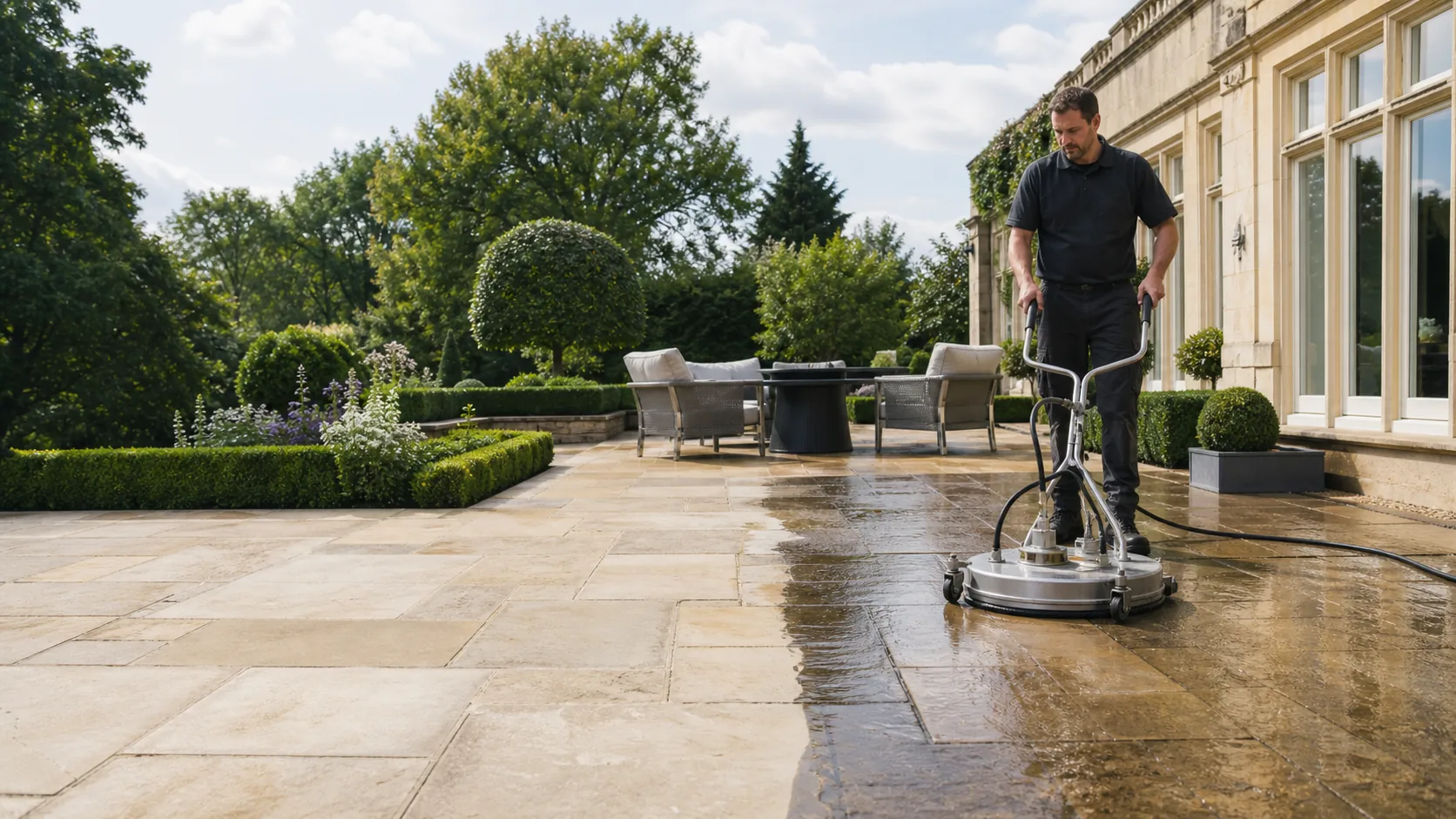
Patio cleaning in Cardiff is rarely a dirt problem. What you are looking at is usually black spot lichen, green algae and a jointing compound that gave up two winters ago. We clean sandstone, porcelain, limestone, slate and concrete slabs across Cardiff and South Wales, and we match the method to the stone rather than to the machine.

Step 1 of 3 · no obligation, reply the same day
The same care and clear communication, whether it is a single path or a whole house.
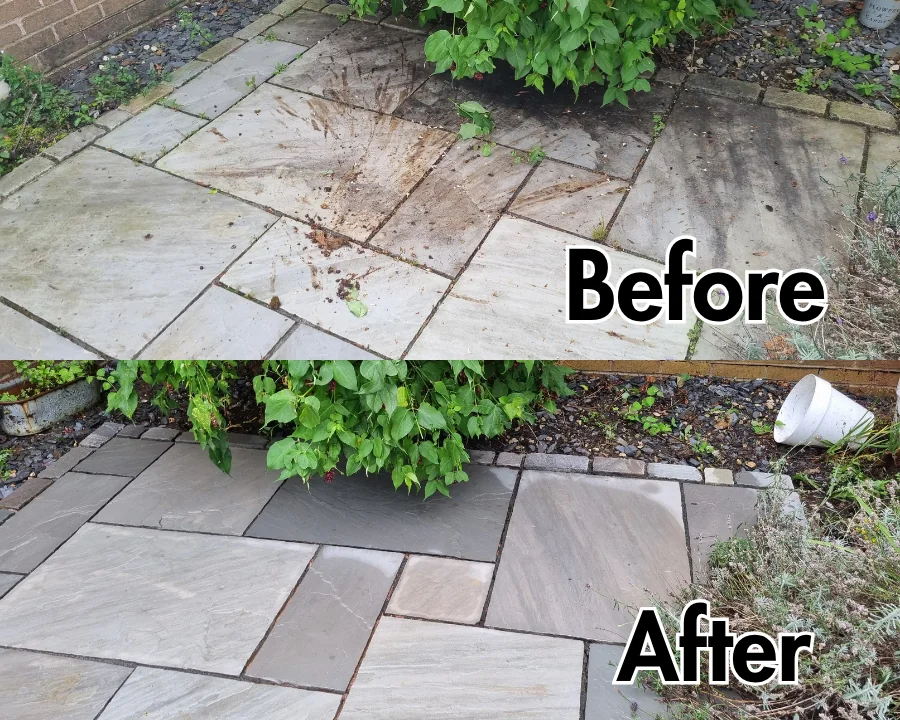
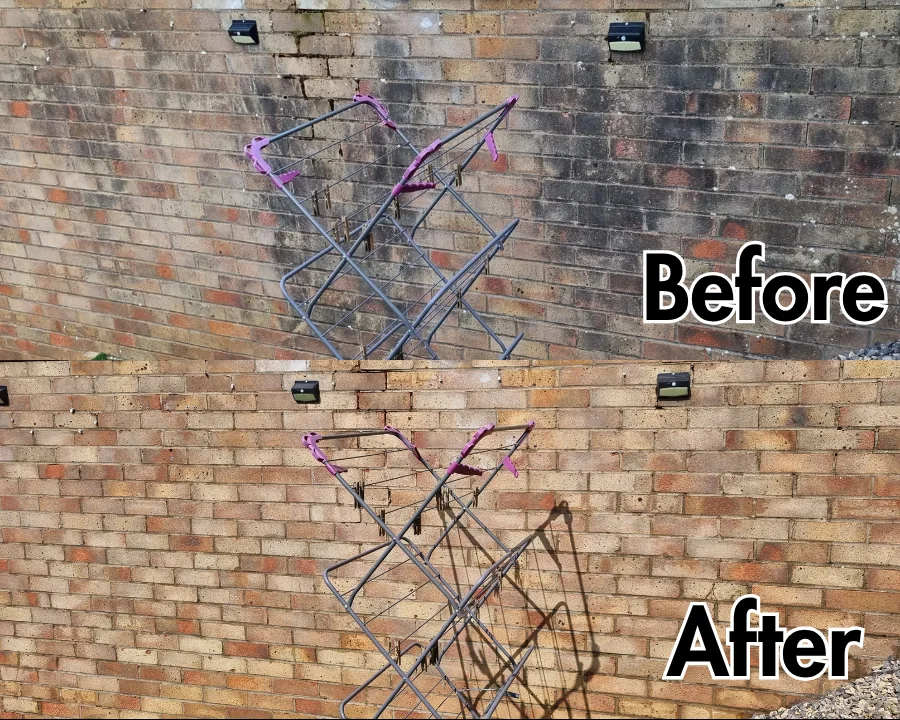
Black spot is not dirt and it is not a stain. It is lichen, a slow growing organism that bonds into the top few millimetres of the stone. What you see as dots is only the visible part of it. The rest has worked into the pores of the slab, which is why it survives a wash that lifts everything else off.
Point a pressure washer at it and the result is predictable. The grime goes, the patio looks better for an afternoon, and the black spots are still there, now standing out more clearly against clean stone. Turning the pressure up does not solve it either. That erodes the slab around the lichen until the marks fade, and leaves a scoured surface that holds the next lot of growth better than the original did.
The method that works is chemical. Once the patio is washed and still clean, we apply a dedicated black spot remover and give it time to dwell. Product choice matters here. Some are sodium hypochlorite based, others are acidic, and an acidic one on limestone or on a lime rich concrete slab will etch the face and leave a chalky patch that cannot be reversed.
Be realistic about timing. The lichen is killed on the day, then the dead residue weathers and fades over the following two to six weeks, with rain and sunlight doing that part of the work. Badly colonised sandstone often needs a second application. A small number of very old, deeply pitted patios never come back perfectly clean, and we tell you that before you book rather than after.
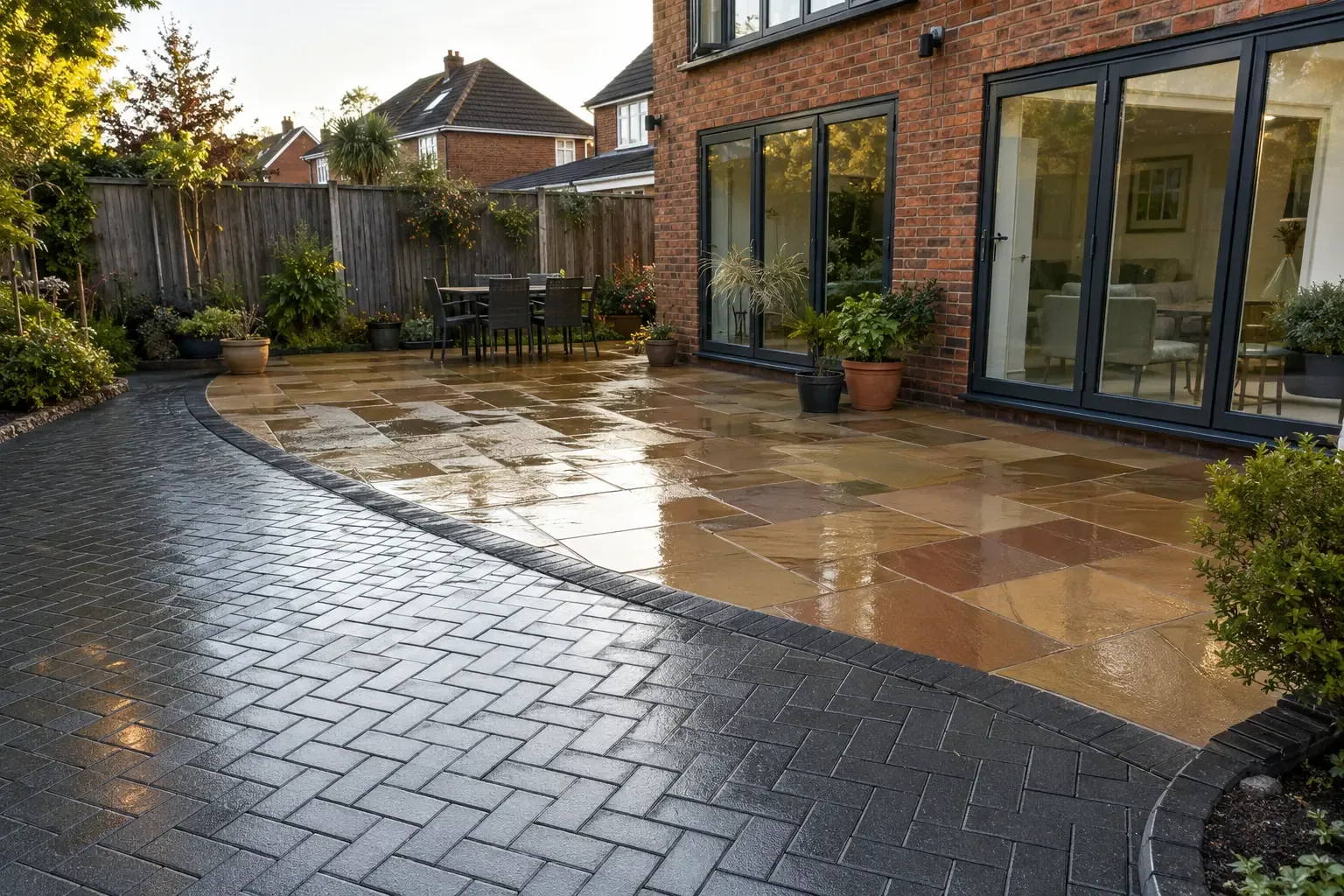
Riven Indian sandstone and pressed concrete can look almost identical under ten years of algae, and they want completely different treatment. So the first job on site is working out what you actually have. If we cannot tell from the face we look at a broken edge or lift a spare slab, because getting this wrong is what ruins patios.
A turbo nozzle concentrates the machine's whole output into a spinning point. On concrete or hard block paving that is useful. On soft riven sandstone it works like a sander, leaving feathered edges, swirl marks and permanent striping wherever the operator's arm slowed down or sped up. It is the most common piece of DIY damage we get called out to look at, and no amount of washing puts it back.
We use a rotary flat surface cleaner instead. Two jets spin under a fixed height housing, so every part of the slab takes the same energy and nothing stripes. Pressure at the surface drops, coverage rises, and far less water is driven down into the joints. On very soft or very old stone we go gentler again, treat it chemically first, and use water mainly to rinse.
Most tired looking patios have a joint problem rather than a slab problem. Sand and cement pointing cracks as the base moves, water gets under it, frost lifts it, and by year five the joints are full of soil, moss and weed seed. Cleaning a patio in that state will take the loose material out, because it had already failed. Better to know that before the wash than to be surprised by it afterwards.
We show you which joints are going before any water goes down. Once the patio is clean and dry there are two routes. A brush-in jointing compound, which needs joints of a decent size, usually around 5mm wide and at least 25mm deep depending on the product, plus a dry spell to cure. Or raking out and re-pointing in mortar where the joints are too shallow for compound to hold. Either way, the joints get sorted before sealing, never after.
Sealer is not paint and it will not stop a patio getting dirty. An impregnating sealer soaks in and repels water and oil from inside the stone, so spills sit long enough to be wiped and algae has less to grip. A wet look sealer sits on the face and deepens the colour, which suits slate and sandstone and looks wrong on some concrete.
Two rules. The stone has to be genuinely dry, which in Cardiff means picking your week, and that means several dry days rather than one dry morning. And it has to be well past any black spot treatment so the chemistry has finished working. Seal damp stone and you trap moisture under a film that goes cloudy. Expect to reseal every two to four years on a patio in regular use. Porcelain does not need sealing, and we will say so rather than sell it to you.
We price per job and fix the figure before we start. As a guide, a straightforward clean on a typical 20 to 40 square metre patio usually falls between £150 and £300. Black spot treatment adds roughly £2 to £4 per square metre, because the product is expensive. Sealing is the bigger addition, commonly £6 to £12 per square metre. Treat all of that as budgeting numbers rather than a quote, because the points below move it in both directions.
Cardiff gives lichen everything it wants. Wet winters, long damp spells and very little hard frost to knock growth back. North-facing patios and anything under mature tree cover go green fastest, which is why we do so much of this work in Penylan, Cyncoed, Lisvane and Roath. Older properties bring their own quirks: York stone flags bedded more or less straight onto soil, and paving tight against a Pennant sandstone wall that never dries out on the shaded side. We cover the rest of Cardiff as well, including Llanishen, Whitchurch, Rhiwbina, Radyr, Llandaff, Canton, Pontcanna, Grangetown, Splott, Rumney, Llanrumney and Cathays, plus Barry, Newport and the wider South Wales area.
Call or message 07576 128903 with a rough size and a photo of the worst corner, and we can usually give you a sensible idea of the cost straight away, then confirm it on site. Email is Liamdunn2406@outlook.com if that suits you better. We answer seven days a week, 7:00 to 21:30, we have been cleaning patios across Cardiff since 2019, and our Google rating is 5.0 from five reviews. Quotes are free and we do not charge to come and look.
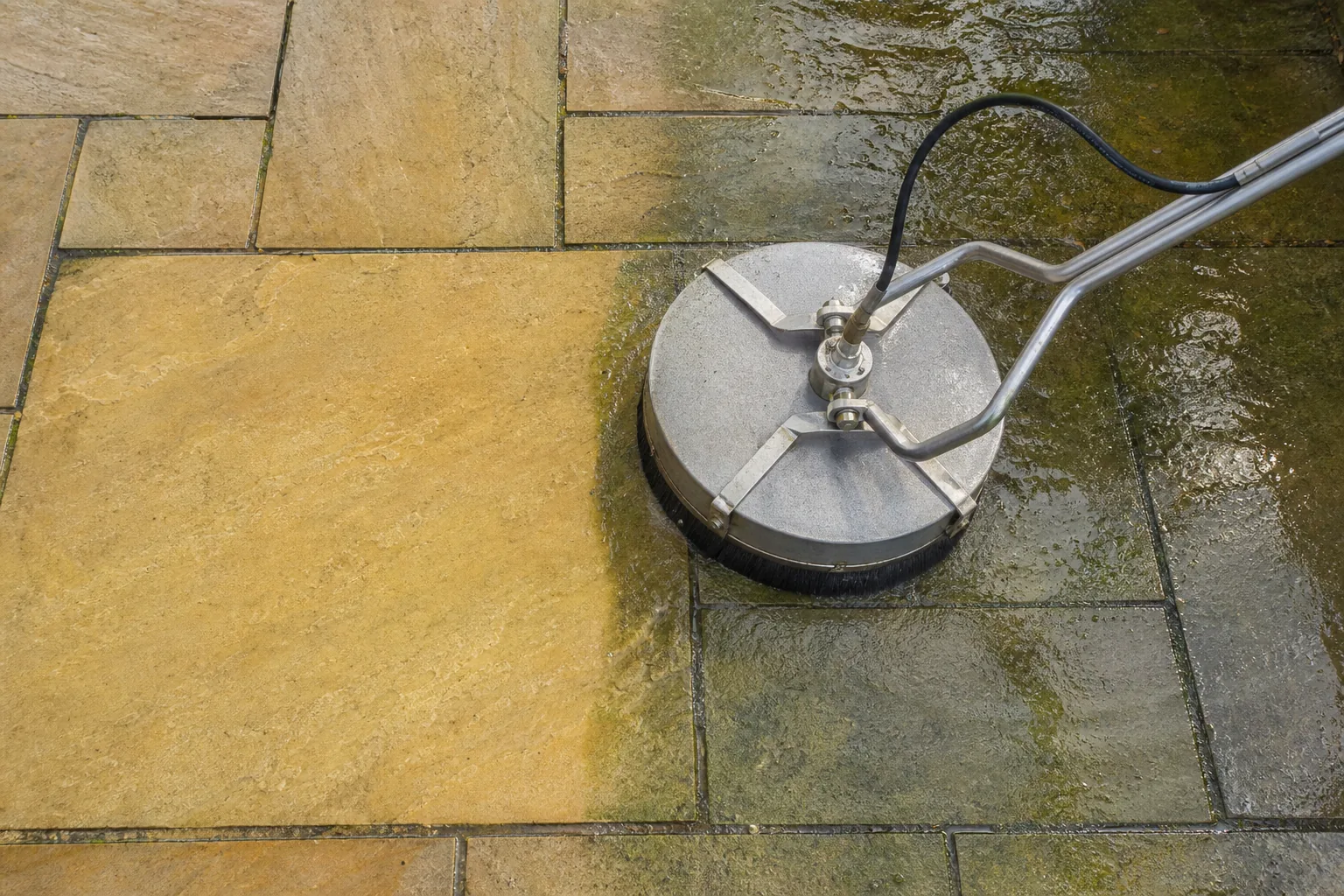
We quote per job and fix the price before we start. As a rough guide, a straightforward clean on a 20 to 40 square metre domestic patio usually falls between £150 and £300. Black spot treatment adds around £2 to £4 per square metre, and sealing commonly adds £6 to £12 per square metre depending on the product. What moves the figure is the surface, how long it has been left, the amount of edge and step work, access for hoses, and whether the joints need re-sanding or re-pointing. Send a photo and a rough size to 07576 128903 and we will give you an honest range before visiting.
Most domestic patios are a half day job, roughly three to five hours including setting up, protecting borders and clearing down. A large patio, or one with heavy black spot, steps and a lot of hand work around planters, can run to a full day. Re-pointing is usually a separate visit because the joints have to be dry first. Sealing is always a separate visit, since the stone needs a proper run of dry weather. We tell you which of those applies when we quote, so you are not left waiting on a van that has not finished.
It can, and we see the results regularly. Riven sandstone is soft and layered, so a turbo nozzle held too close lifts the top skin and leaves swirl marks and striping that never wash out. The safer approach is a rotary flat surface cleaner run at lower pressure, which spreads the energy evenly, with chemistry doing the work the water should not be doing. Limestone, slate and coloured concrete are just as easy to damage. If a slab is already flaking or the pointing is failing, we show you before we start rather than after.
Usually, but not instantly and not with water. Black spot is lichen rooted into the stone, so it needs a dedicated black spot remover applied after the patio has been washed. The lichen dies on the day, then the dead marks fade over roughly two to six weeks as rain and sunlight break them down. Heavily affected sandstone often needs a second application, and a very old, deeply pitted patio may keep faint shadows. We tell you honestly which category yours falls into when we look at it, because it changes what the finished result will be.
On an open, sunny patio you would normally expect two to three years before it needs doing again. A north-facing patio, or one under trees or tight against a shaded wall, can green up within twelve to eighteen months because it stays damp through most of the Welsh winter. Sealing extends it, mainly by making dirt easier to shift and slowing algae getting a grip. A light wash once a year stops it ever returning to the state it was in, and sweeping leaves off in autumn makes more difference than most people expect.
Not for the whole job, but we do need a few minutes with you at the start to agree the finish, look at the test patch and point out anything already damaged. After that you can go out. We need access to an outside tap and to the patio itself, so a side gate that opens, or a key left with a neighbour, works fine. We can send photographs of the finished job, and payment is taken afterwards. If the joints need re-pointing, or you want the patio sealed, we book that separately.
Planting within splash range is soaked with clean water first and sheeted, then rinsed again at the end, which is what stops any treatment sitting on leaves at strength. Keep pets and children off the patio while we are working and until the surface has been rinsed and has dried. Wash slurry is directed away from the house and away from open gullies where we can, and any silt left in a drain cover is cleared before we leave. Tell us about a pond, a vegetable bed or a soakaway and we will work around it.
Late spring and early autumn are ideal in Cardiff. The patio dries between showers, growth is active so treatments work properly, and you get the surface back either side of the season you actually use it. We work through the winter too, though we stay off paving that is frozen, and sealing has to wait for a genuinely dry spell. Midsummer heat is not the advantage people assume, because products dry on the stone before they have had time to dwell. If you are booking around an event, allow a few weeks in case a second black spot application is needed.
Great company come out gave a good price and done the job straight away highly reccomend chris great guy

Very reliable, showed up on time to give a quote, and started work straight away! Wanted the back done after the front. Stunning work on my front driveway and porch with the power washer, simply removed all the algae on my walls too that the pressure washer team we had last year couldn't do.

Hard working and reliable pressure washing company! Completely transformed my paving stones and patio

Very happy with the service provided from pressure washing Cardiff, also very friendly and professional many thanks, Simon
What a good quality service have provided done a superb job of pressure washing my driveway + house. Many thanks, Shane
My husband and I are very happy with the work done at our house, to our gutters, our pool area and other concrete areas around our house. You were a pleasure to deal with and I will definitely use your services again!
Pressure Washing Cardiff did a fabulous job: our concrete driveway and retaining walls look like new! What a delight to have a tradesman visit who takes pride in his work and does a thorough job.
These guys are experts and were able to give us a great quote for a complete exterior makeover. Power washing, gutter cleaning, window cleaning as well as pressure washing for our patio and driveway. Thank you so much!!
Send a photo and a rough size and we will come back with a price, usually the same day.
20% off enquiries via WhatsApp