
Moss is a plant, not a stain
Moss has no true roots. It grips with fine hairs called rhizoids that hook into any texture in the surface, and it takes water in across its whole body, which is why a dry green crust turns lush within an hour of rain. There is nothing underground to starve out, because there is nothing underground.
It spreads by spores, not seeds. Spores are microscopic. They travel on wind, tyres, boots, birds and mower wheels, and one established clump releases them in their millions. Your driveway is reseeded within days of any clean, whatever was used on it. So the useful question is not how to get rid of moss for good. It is how far out you can push the return.
The five conditions moss needs
The first four have to line up at the same time. Take one away and the growth rate falls off a cliff. Take none away and you are cleaning the same slabs every year.
- Moisture that lingers. Not the rainfall itself, but how long the surface stays wet once the rain stops.
- Shade. A few hours of direct sun a day dries a surface out and scorches young growth before it establishes.
- Texture to grip. Open pores, a worn face, sand joints, hairline cracks, the rough side of riven stone.
- A thin nutrient film. Dust, pollen, rotting leaf litter and the honeydew that drips off aphid-covered trees.
- Being left alone. This is why the wheel tracks on a driveway stay clear while the edges and the kerb line green over first.
Why it comes back faster in South Wales
Cardiff is one of the wettest cities in Britain. We get well over 1,000 mm of rain in a normal year against nearer 600 mm in the driest parts of eastern England, and it arrives across roughly 150 separate wet days rather than in a handful of downpours. The weather comes off the Atlantic warm and saturated, and the prevailing south-westerly drives it straight onto the front elevation of most houses here.
Winter matters more than the annual total. Moss photosynthesises at temperatures barely above freezing, and Cardiff winters rarely stay frozen for long. November to March is not a dormant season for moss, it is the growing season, and it lands exactly when surfaces get the least sun and dry the slowest. Everything else in the garden stops. Moss speeds up.
A north-facing surface is the single biggest predictor
At Cardiff's latitude the midday sun in December sits about 15 degrees above the horizon. At that angle a standard 1.8 metre fence panel throws a shadow almost 7 metres long. If there is a fence, a hedge or a house wall on the south side of your driveway, that driveway sees no direct sun at all from October through to March.
We clean semi-detached houses in Llanishen and Rhiwbina where the shaded side path is furred with moss while the sunny side, same slabs, same age, same wash date, is barely marked. Aspect is usually the whole story, and it is the one variable you cannot change.
Overhanging trees do three jobs for the moss at once
They shade the surface. They shed litter that rots down into exactly the nutrient film moss wants. And the canopy kills the airflow, so the ground underneath holds moisture for hours after everything around it has dried. Lime and sycamore add a fourth problem, and the mature limes on the older streets around Penylan and Roath are the worst offenders. Aphids on the leaves drip honeydew, algae feed on the honeydew, and moss follows the algae.
A drive under a mature canopy greens over again within nine to twelve months however well it was cleaned. Crown lifting, or simply taking the overhanging limbs back off the boundary, shifts that number further than any product we can put down.
Porosity decides how deeply it takes hold
Porcelain paving absorbs well under 0.5 per cent of its weight in water. Concrete flags take on several per cent. Riven sandstone varies enormously by quarry and some of it drinks more than concrete does, and tarmac that has lost its binder behaves like a sponge. The more open the surface, the longer it stays wet, and the more places there are for spores and rhizoids to sit where no spray reaches. Age counts too. New concrete has a closed face, and twenty years of frost, road salt and tyres wears that face away.
Why does moss keep coming back after a pressure wash?
Because a wash removes what you can see and nothing else. It leaves spores in the pores and the joints, it does not change the aspect, and it does not change how long the surface stays wet. The plant is gone. Every condition that grew the plant is still there.
An aggressive wash often makes the next colonisation faster. It opens the surface, drives litres of water into it and blows the jointing sand out. What you get back is a clean, rougher, wetter surface with the competition stripped off it, which is close to ideal growing conditions. That is the trap. The drive looks its best on the day it is cleaned and is more receptive than it was before.
The repair work we get called out to is nearly always the same short list, and all of it comes from too much pressure held in one spot for too long.
- Kiln-dried sand blown out of block paving joints, which lets weeds in and lets the blocks rock and settle.
- Concrete etched into visible stripes where the lance was held too close or swept unevenly.
- Sealer stripped off imprinted concrete, so it now needs resealing rather than just cleaning.
- Riven sandstone and limestone pitted by a turbo nozzle, which is permanent.
- Tarmac binder broken up, leaving loose chippings that wash down into the gully.
- Water forced into mortar joints, under slabs and occasionally past a low damp-proof course.
What actually extends the interval
Nothing is permanent. What is realistic is turning a twelve month cycle into two to three years without wearing the surface out to get there. The order of the work matters more than which products are used.
- Fix the water first. Before anything is cleaned, work out why the surface stays wet. An overflowing gutter, a split downpipe shoe, a silted soakaway, a gravel board holding water against the edge, a fall running back towards the house. Cleaning around a permanent water source is money down the drain.
- Clear the debris dry. Leaves, needles, silt and the compost that builds up along kerbs and against gravel boards come off dry with a stiff brush and a blower. Wet leaf mulch hit with a lance just smears into the pores and feeds the next flush of growth.
- Clean at the pressure the surface can take. Sound concrete and block paving take a rotary surface cleaner at working pressure. Older flags, natural stone and decking do not, and render, painted masonry and roof tiles should never see a pressure lance at all. Those get soft washing, which is low pressure and the right chemistry doing the work. Matching the method to the substrate is most of the skill in this trade.
- Put the joints back. Block paving needs re-sanding with kiln-dried sand after any proper clean, brushed in and vibrated down. Blown patio joints need repointing. An open joint is the wettest, most sheltered spot on the whole surface, and it is where the moss comes back first.
- Treat, do not just rinse. A biocide applied at low pressure after cleaning kills what the wash left behind in the pores. The usual trade actives are DDAC and benzalkonium chloride. They want a dry surface, a dry spell behind them and time to work, which is why we book treatments around the forecast rather than the diary. This is the step most people skip and it is the one that moves the interval.
- Maintain instead of rescuing. A light biocide application every twelve to eighteen months stops the surface ever needing another heavy wash. Repeated deep cleaning is what wears paving out. Treating is what makes deep cleaning unnecessary.
How long it should realistically last
These are the intervals we see on Cardiff jobs after a proper clean followed by a biocide treatment. Without the treatment, take roughly a third off every one of them.
- Open south-facing or west-facing driveway, no trees, sealed block paving: three to four years.
- Open, unsealed, with drainage that works: two to three years.
- East-facing and shaded for part of the day: eighteen months to two years.
- North-facing with a fence or wall on the sunny side: twelve to eighteen months.
- North-facing under a canopy, or a path down the shaded side of a Grangetown or Splott terrace: nine to twelve months, sometimes less.
- North roof pitch under trees: visible regrowth within two to three years even after a full treatment, and that is normal.
When the honest answer is do not bother
Do not have a shaded north-facing path washed in November. It will not dry, so no treatment can do its job, and it will be green again by February. Wait for a settled run in March or April and get two extra seasons out of the same money.
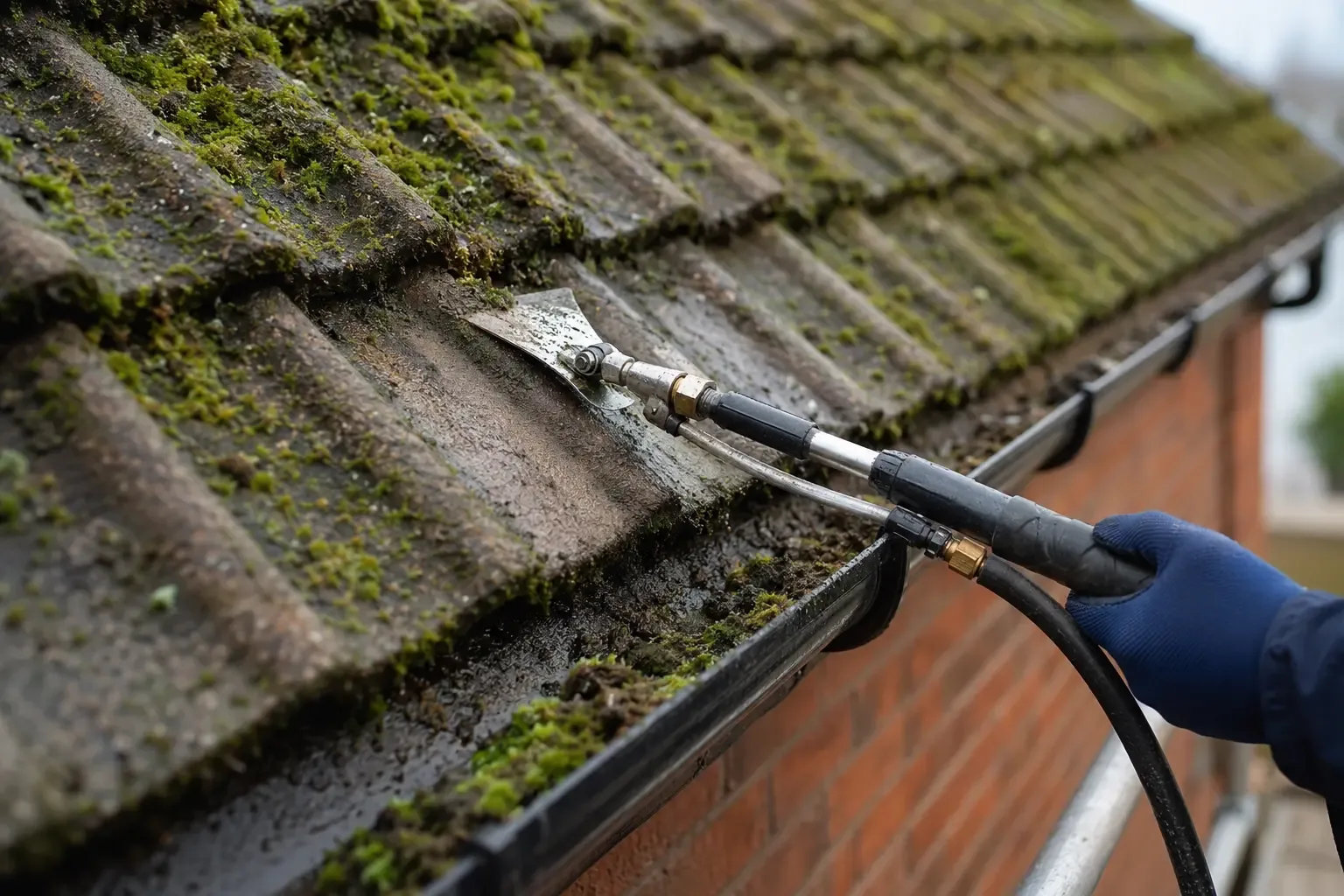
Do not pressure wash a roof, ever. Water gets under the laps, the jet strips the granules off concrete tiles and takes the face off older clay ones, and a lance will put a tile through the ceiling. Roof moss is scraped and brushed off by hand, then treated, and even then it comes back, because a roof is the shadiest, wettest, least disturbed surface you own.
And do not clean on appearance alone. The real reasons to clean are slip risk and damage to the surface. A thin green film on a well-drained drive you rarely walk on can wait another year, and the money is better spent on the surface that is genuinely a hazard, which is usually a shaded side path or a set of steps.
Sealing, and what it will and will not do
Sealing block paving or imprinted concrete cuts the porosity, locks the jointing sand in place and makes the next clean far gentler. It does not stop moss. Growth still lands on top, it just cannot anchor deeply, so it lifts with a brush instead of needing a lance. Expect three to five years from a good sealer on an open driveway and less than that on a shaded one. Sealing riven natural stone is a separate decision about staining rather than moss, and tired tarmac wants a restorative coating rather than a paving sealer.
The free things that make the most difference
Sweep the leaves off in October and November instead of letting them rot down over winter. That single habit removes the nutrient layer and the moisture mat in one job. Cut back whatever overhangs. Clear the guttering so the downpipe is not soaking one corner of the drive every time it rains. A stiff brush over the shaded edges twice a year, before the growth thickens up, keeps a surface presentable far longer than an annual deep clean does.
If you want a second opinion on why one particular surface keeps greening over, send a photo and a rough size in square metres. We have been cleaning driveways, patios, render and roofs across Cardiff and South Wales since 2019, and we will tell you whether it needs cleaning, treating, both or neither before we quote. Call 07576 128903 or email Liamdunn2406@outlook.com.