The short answer, then the caveats
For most Cardiff homes the honest schedule is a full clean every 18 to 24 months on block paving, every two to three years on brushed concrete, and on tarmac only once growth shows, which is often three or four years apart. Treat those as starting points. What sets the real date is how quickly the green comes back, and that is decided by how much sun the drive gets rather than by the material under your feet.
Why driveways green over faster in South Wales
Cardiff records somewhere around 1,150 mm of rain in an average year. Large parts of the south east of England sit closer to 600. The pattern matters more than the total. Ours arrives thinly, across a lot of separate days, so paving stays damp for weeks instead of getting a soaking and then drying out properly. Algae, moss and lichen are not living on dirt. They want moisture, shade and a rough surface to grip.
The mild winter does the rest. We rarely get the run of hard frosts that holds growth back for weeks at a time further north, so the green film keeps creeping along through January and February. That is why a schedule lifted from a national guide reads about six months optimistic once you apply it here.
How often should you clean your driveway, by surface
These are the intervals we would give a Cardiff homeowner with a drive in average conditions: some direct sun, no heavy tree cover, normal daily use.
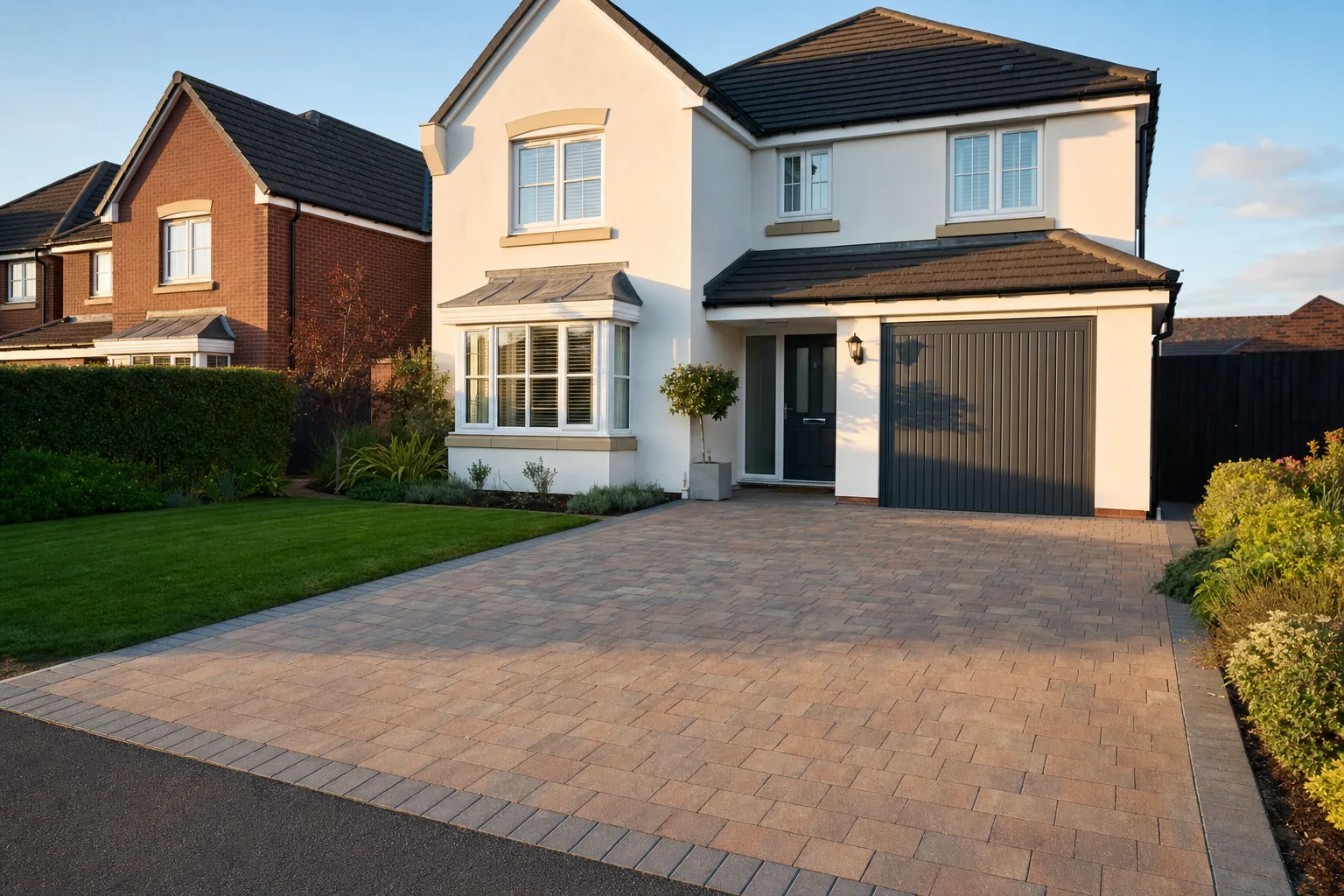
- Block paving: every 18 to 24 months. The joints fail first. Moss roots in the sand, holds water against the block edges and works the interlock apart.
- Brushed or poured concrete: every two to three years. It takes pressure well, but it is porous, so algae stains it far more visibly than it stains coloured block.
- Imprinted or pattern concrete: every three to five years, and tie it to the sealer rather than to the dirt. Clean it when you are ready to reseal, because cleaning removes whatever is left of the old coat.
- Tarmac: every three to four years, and only once growth shows. Cleaning tarmac means killing moss at low pressure. It is not a way of getting the colour back.
- Resin bound: a rinse each year and a proper soft wash every two to three years. Never a rotary head at full pressure, which pulls the stone out of the resin and leaves bald patches you cannot repair invisibly.
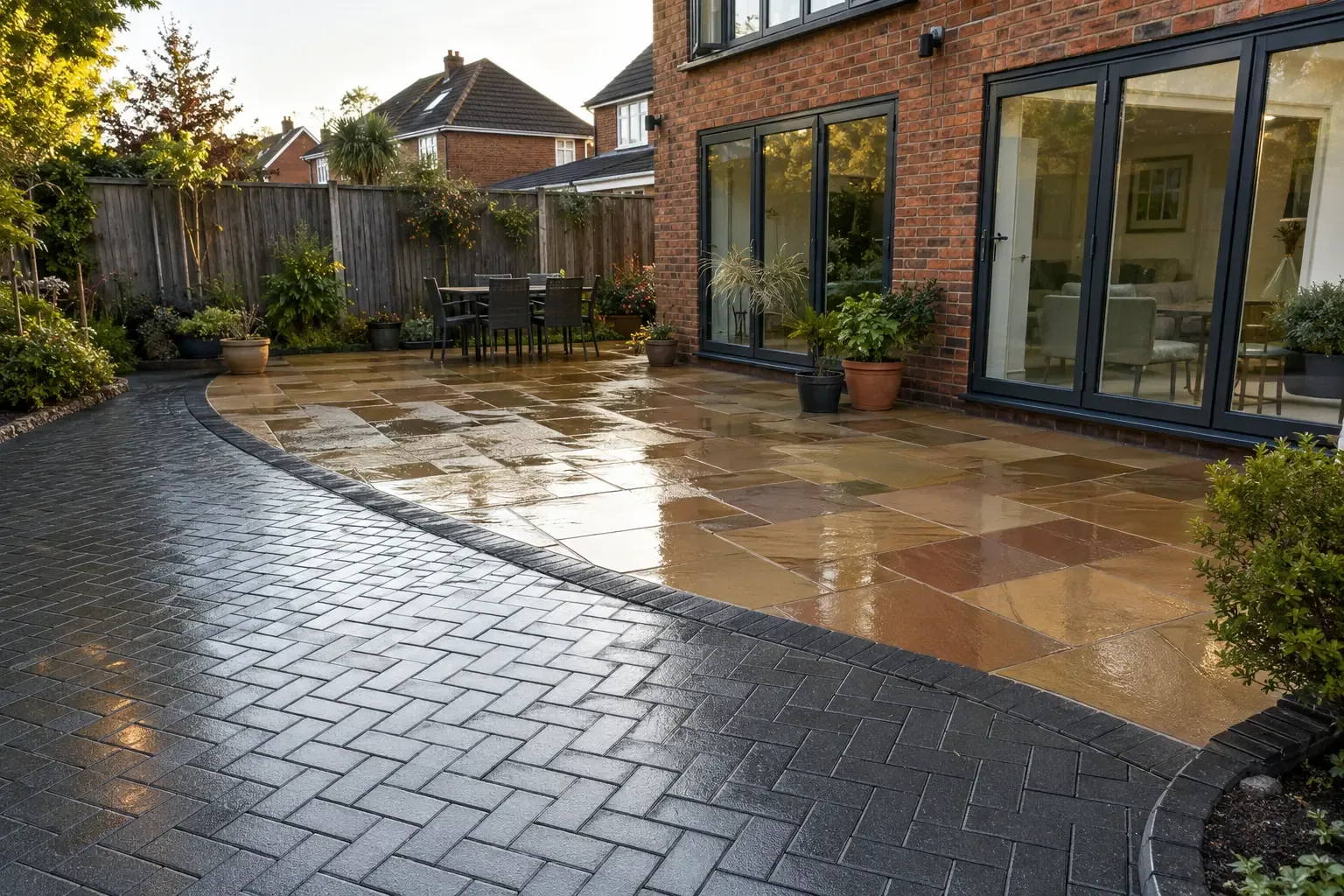
- Indian sandstone and other natural stone: every 12 to 18 months, because of black lichen spotting. Leave it three or four years and the spots root into the stone and become very hard to shift.
- Victorian tiled or flagged front paths, common on the terraces in Roath, Canton and Grangetown: every two to three years, by hand and at low pressure. Those tiles sit on lime mortar and a rotary head lifts them straight out.
- Gravel: no schedule at all. Rake it, top it up, and replace the membrane underneath when weeds start coming through. Do not take a lance to it.
What moves your own drive up or down that scale
Two identical block paved doubles, one in Rhiwbina and one in Roath, can need cleaning years apart. This is what decides it.
- Aspect. A north-facing drive that loses the sun by lunchtime can green over inside twelve months. A south-facing one in the open often still looks respectable at three years.
- Overhanging trees and hedges. Leaf fall feeds the surface, sap makes it sticky, and the canopy stops it drying. A drive under a laurel hedge in Cyncoed or Lisvane is on the short schedule whatever it is made of.
- Gutters and downpipes. One overflowing joint tips water and roof silt onto the same strip of paving all winter. That strip greens first, and cleaning it without fixing the gutter simply resets the clock.
- Falls and drainage. Water that stands in a low corner, or backs up along the kerb line, grows moss there long before the rest of the drive needs anything.
- How much the drive is used. Tyres and feet scuff growth off before it thickens. The unused half of a double is reliably the green half, and so is the rectangle behind the bins.
- Whether it has ever been sealed. A sealed block drive sheds water and stays cleaner for longer, but the sealer has a life of roughly three to five years, and once it breaks down the surface behaves like any other.
The signs it is due early
Ignore the calendar if you can see any of this.
- It is slippery underfoot when wet. That is the one that matters. Algae on a sloping drive is a genuine fall risk, and it is behind most of the calls we take in January.
- It looks dull and grey when dry, then goes green or black the moment it rains.
- Moss cushions in the joints or along the edging course.
- Weeds growing in the joints. Weeds mean the jointing sand has gone, which is structural rather than cosmetic.
- Black spotting on sandstone that a stiff brush will not touch.
- Silt banking up at the low edge, or water pooling round the gully instead of draining away.
What leaving it too long actually costs
Appearance is the least of it. Once moss has sat in block paving joints for a few years it forces the remaining sand out. The blocks lose the interlock that makes paving behave as one surface, and they start to move under a car. Sunken wheel tracks and a dropped edging course follow, and relaying costs several times what a clean does.
Moss also holds water against the surface. On concrete and on older, softer blocks the frosts we do get can lift the face off in flakes. On tarmac it speeds up the crumbling that always starts at the edges. Black lichen left on sandstone for three or four years is often there for good. And a drive ignored for a decade needs a harder clean, which takes more off it than three gentle ones ever would.
What a full clean actually involves
It helps to know what you are paying for, because the machine work is the short part. On a standard Cardiff double we pre-treat the growth, then work the surface with a rotary flat plate rather than a bare lance, since a lance leaves stripes and cuts lines into concrete. Oil patches get hot water and a degreaser before anything else touches them.
- Pre-treatment. A biocide put on a week or two beforehand kills the growth so it lifts out dead rather than being blasted around live.
- Rotary flat plate. It holds the jets at a fixed height with an even overlap, which is the reason a properly machine cleaned drive has no stripes across it.
- Hot water where it earns its keep. Oil, chewing gum and bin residue need heat and a degreaser. Cold water spreads them.
- Soft washing for anything that cannot take pressure. Render, roofs, resin bound surfaces and imprinted concrete are cleaned with chemistry at low pressure instead.
- Re-sanding. Kiln dried sand brushed into block paving joints on a dry day, otherwise the clean has left the drive weaker than it found it.
- Clearing the slurry. Sand, silt and dead moss are lifted out and taken away rather than flushed into the gully.
The yearly routine that stretches the interval
- Look at it in February, in the wet. Growth peaks at the end of a Cardiff winter and a dry surface hides it. Walk the drive while it is raining. Slick underfoot, or joints that feel spongy, means it is due now rather than in the summer.
- Cut back whatever is shading it. An hour with the secateurs buys more time than a wash does. Lift the canopy, take the hedge back off the edging, and let light onto the surface so it can dry between showers.
- Clear the gutters. A gutter overflowing onto one strip of paving will regrow moss there within months of a clean. Fix the cause before you pay anyone to treat the symptom.
- Treat it in spring instead of washing it. A hard-surface biocide watered on with a can, typically £20 to £30 of concentrate for a double, kills the film before it thickens and puts no wear on the surface at all. Choose dry, still weather and keep it off the borders.
- Top up the jointing sand. A bag of kiln dried sand brushed into open joints on a dry day holds the interlock and slows the weeds down. It is the cheapest structural maintenance a driveway ever gets.
- Book the machine when treating stops working. Once a biocide no longer clears it, the growth is rooted and mechanical cleaning is justified. On Cardiff block paving that usually lands at the 18 to 24 month mark.
When cleaning is not worth paying for
There are jobs we talk people out of. If one of these describes your drive, keep your money for now.
- It was laid inside the last twelve months. Nothing has weathered yet and the jointing sand is still bedding in.
- It is failing rather than dirty. Sunken tracks, rocking blocks and a collapsed edging course only look worse once everything around them is clean.
- It is a light green film and nothing else. A watering can of biocide clears that for the price of the concentrate, and a full clean now is money spent on wear.
- It is grey oxidised tarmac and you want it black again. Cleaning takes off what grows on tarmac. Putting the colour back is a coating job, not a washing job.
- It is imprinted concrete and you have no intention of resealing. Cleaning strips the remaining sealer, and unsealed imprinted concrete fades and picks up dirt quickly.
Cleaning too often is its own mistake
Washing block paving every spring is not conscientious, it is wearing the drive out. Pressed concrete blocks carry their colour in the top few millimetres, and every rotary pass takes a little of that face away. After eight or ten annual cleans the blocks go patchy and the aggregate starts to show through. Each wash also flushes out jointing sand that then has to be replaced, so the paving never settles properly.
Getting the timing right for your own drive
Not sure where yours sits? Look at it on a wet day in February. Slippery, or soft green joints, means now. Merely tired means treat it and leave the machine until next year. We have been cleaning driveways across Cardiff, Barry, Newport and the rest of South Wales since 2019, seven days a week from 7:00 to 21:30, and we will tell you plainly if yours can wait. Call 07576 128903 or email Liamdunn2406@outlook.com.