The short answer on driveway cleaning cost
Across Cardiff, a straightforward clean, meaning wash, rinse and re-sand with no sealing, lands in these bands. A small single driveway is usually £90 to £160. A standard double is £150 to £280. A large drive, or a drive and path done in the same visit, runs £250 to £450. Treat all of that as indicative. Nobody can price a drive properly without knowing the size, the surface and how long it has been left.
Underneath those bands sits a rate. Cleaning alone works out at roughly £5 to £10 per square metre, and most firms, us included, hold a minimum charge of about £80 to £120. Setting up, running hose, pre-treating and packing down takes the same hour on 8 square metres as it does on 80. National price guides quote higher rates than that, but read what they include. They usually fold sealing into the same figure, and sealing is the expensive half of the job.
Work out your driveway size first
Every honest quote starts with square metres, so measure before you ring anyone. Length times width. If you cannot face the tape measure, count car spaces. One parked car takes up roughly 12 square metres once you allow room to open a door.
- Small single: one car, roughly 10 to 15 square metres. Typical of the converted front gardens on the terraces in Canton, Splott and Grangetown.
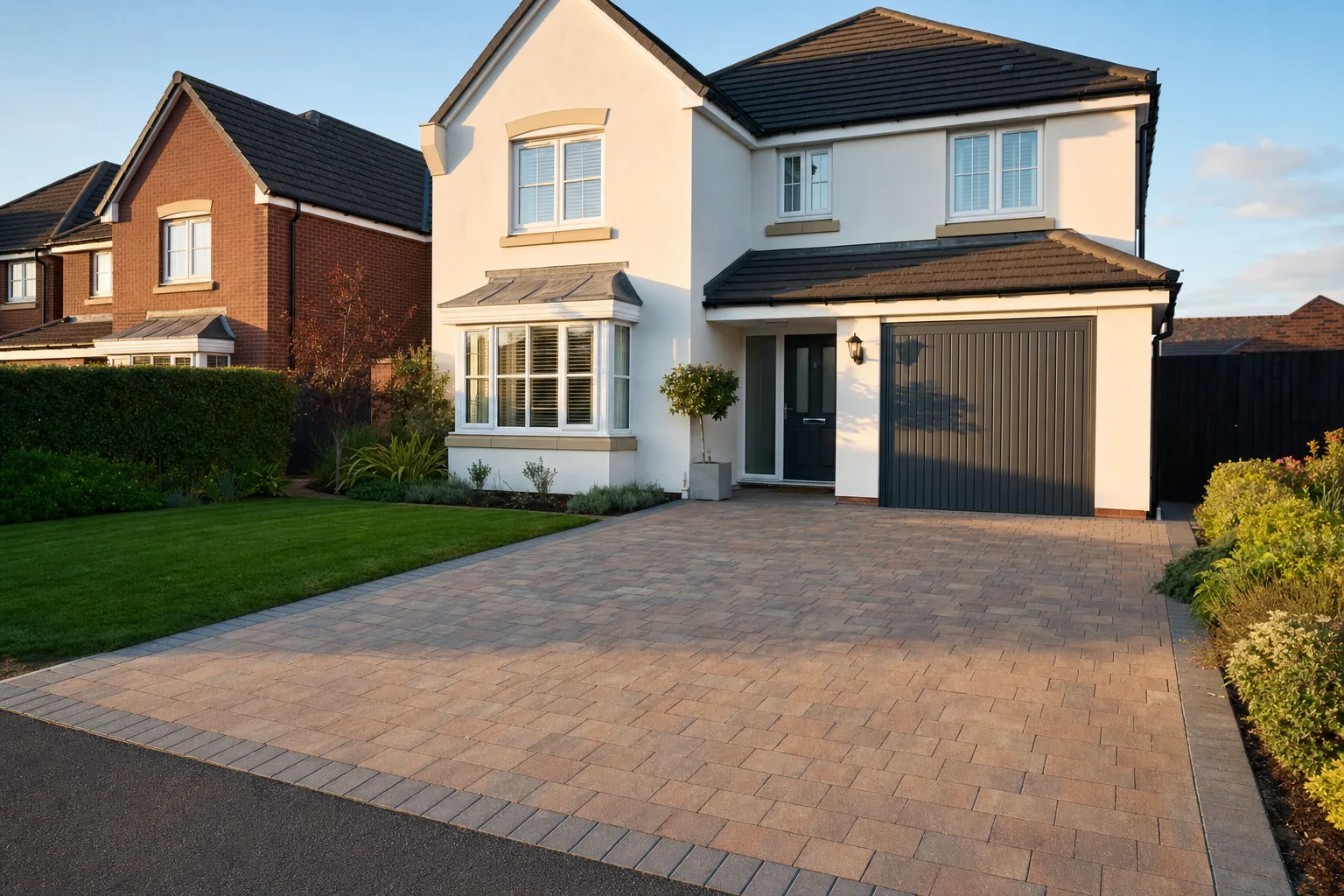
- Standard double: two cars side by side, roughly 25 to 35 square metres. This is the most common Cardiff job by a distance, from Llanishen and Whitchurch across to Penylan.
- Large: three cars, or two plus turning space, roughly 40 to 60 square metres. Common in Cyncoed, Lisvane, Radyr and Rhiwbina. Above 60 square metres you are into bespoke pricing.
- Paths and side returns: normally 1 to 1.5 metres wide, so a 12 metre path is only about 15 square metres. Add them to the same visit and you pay for one set up instead of two.
- Steps, kerbs and the dropped kerb outside: small areas, but they are all lance work rather than rotary work, so they take longer per square metre than the open drive does.
Give whoever quotes you the measurement and the surface, then ask for the price in writing. A number offered without either is a guess, and guesses get revised upwards on the day.
Indicative prices by surface
Surface decides more than dirt does. Some materials take a rotary head at full pressure without complaint. Others are wrecked by it, so the work goes slower, leans on chemistry rather than force, and gets priced accordingly.
- Block paving: the benchmark. A standard double is typically £150 to £280 cleaned and re-sanded. Jointing sand comes out with the dirt, so re-sanding is not optional.
- Brushed or poured concrete: usually the cheapest per square metre, often £4 to £8, because it is hard, flat and takes full pressure. Expect £130 to £240 on a double.
- Imprinted or pattern concrete: add 20 to 40 percent. The colour sits in a thin surface layer under a sealer, and old flaking sealer has to come off first. Cleaning it without re-sealing usually looks worse than leaving it alone.
- Tarmac: low pressure and chemical only. A rotary head at full pressure lifts the bitumen and scars it for good. Cleaning strips moss and green film, but it will not turn grey oxidised tarmac black again.
- Resin bound and resin bonded: soft washing and low pressure only. High pressure blows the stone out, and resin bonded, where the stone is scattered onto the resin rather than mixed through it, gives up faster than resin bound. Similar money to block paving for slower work.
- Indian sandstone and other natural stone: the clean is simple, the black lichen spots are not. They need a dedicated treatment and dwell time, so add £2 to £4 per square metre, and expect them back if the stone stays in shade.
- Victorian tiled paths: the geometric clay tiles on the older Roath, Pontcanna and Canton terraces sit on lime mortar and are often cracked already. Full pressure lifts them. These are hand work at low pressure and get quoted on the day, not by the square metre.
- Gravel: not a pressure washing job at all. Rake it, top it up, or replace the membrane underneath.
What actually changes the number
Two identical 30 square metre drives on the same street can be quoted £70 apart. Here is what sits behind that.
- Time since the last clean. Ten years of compacted moss and root growth in the joints can double the labour compared with a drive that was done two years ago.
- Access. If the van cannot park within about 30 metres, hose has to run through a side gate or up a rear lane. The terraced streets around Cathays and Roath are the usual culprits.
- Water. We work off your outside tap and carry our own hose. No usable tap means bringing water in, and that costs.
- Oil and tyre staining. Oil soaked into concrete needs a degreaser, heat and dwell time. It is usually improved rather than erased, and an honest quote says so up front.
- Gradient. Plenty of Cardiff drives fall towards the house rather than the road, so the water has to be caught and pulled out at the bottom instead of running against the threshold or onto next door's frontage.
- Old sealer. If a previous coat is flaking or has gone milky, it has to be stripped before anything else happens, and stripping is slower than cleaning.
- Established weeds. They want killing before the clean, not during, which can mean a short treatment visit a week or two ahead.
What a suspiciously cheap quote leaves out
Nobody quoting £60 for a double driveway is doing the same work for less money. They are doing less work. Usually one of these is missing.
- Re-sanding. Washing block paving flushes kiln dried sand out of the joints. Left empty, blocks lose their interlock, rock under a car and let weeds germinate faster than before.
- Drain protection. A clean produces slurry: sand, silt, moss and biocide. On the separate surface water systems used across the newer Cardiff estates, whatever goes down the gully ends up in a watercourse. Screen it and collect the solids.
- Waste removal. The silt has to go somewhere. Swept into your border or against the kerb, it is your problem again next week.
- Cover for the damage. Water forced under a door threshold, pointing blown out of a wall, a stone chipped through a car panel. Ask whether they are insured before they start rather than after.
- The right method. Cheap work is cheap because everything gets the same head at the same pressure, which is fine on concrete and destructive on tarmac, resin and imprinted concrete.
- A written price. The verbal number with no measurement behind it is the one that grows once the machine is running.
Re-sanding and sealing, and which one you need
Re-sanding is maintenance, not an upsell. Once the surface has dried, kiln dried sand goes back into the joints, is brushed in and gets topped up after it settles, which is usually a few days later once rain has knocked it down. Skip it and the driveway is structurally worse than it was before the clean. On a standard double it is £20 to £60 where it is itemised at all.
Sealing is a genuine choice. A decent sealer on block paving costs roughly £7 to £14 per square metre applied, so another £200 to £450 on top of the clean for a standard double, and porous blocks drink the first coat. You get joint stabilisation, easier weed control, less staining and stronger colour for about three to five years. What sealing needs above all is a dry surface. Put it on damp paving and it goes milky white, then it has to be stripped, which is why sealing through a Cardiff January is a bad idea.
How a driveway clean actually runs
- Survey and test patch. Measure the area, identify the surface, then clean a small hidden patch at working pressure. That patch settles any argument about the finish before the whole drive is committed.
- Protect the property. Cars moved off, air bricks and thresholds covered, planting sheeted, and a filter over the gully so silt and sand are caught rather than flushed away.
- Pre-treat. Weeds, moss and algae get a treatment and time to work. Killing growth first is faster than blasting living roots out of the joints, and it comes back slower afterwards.
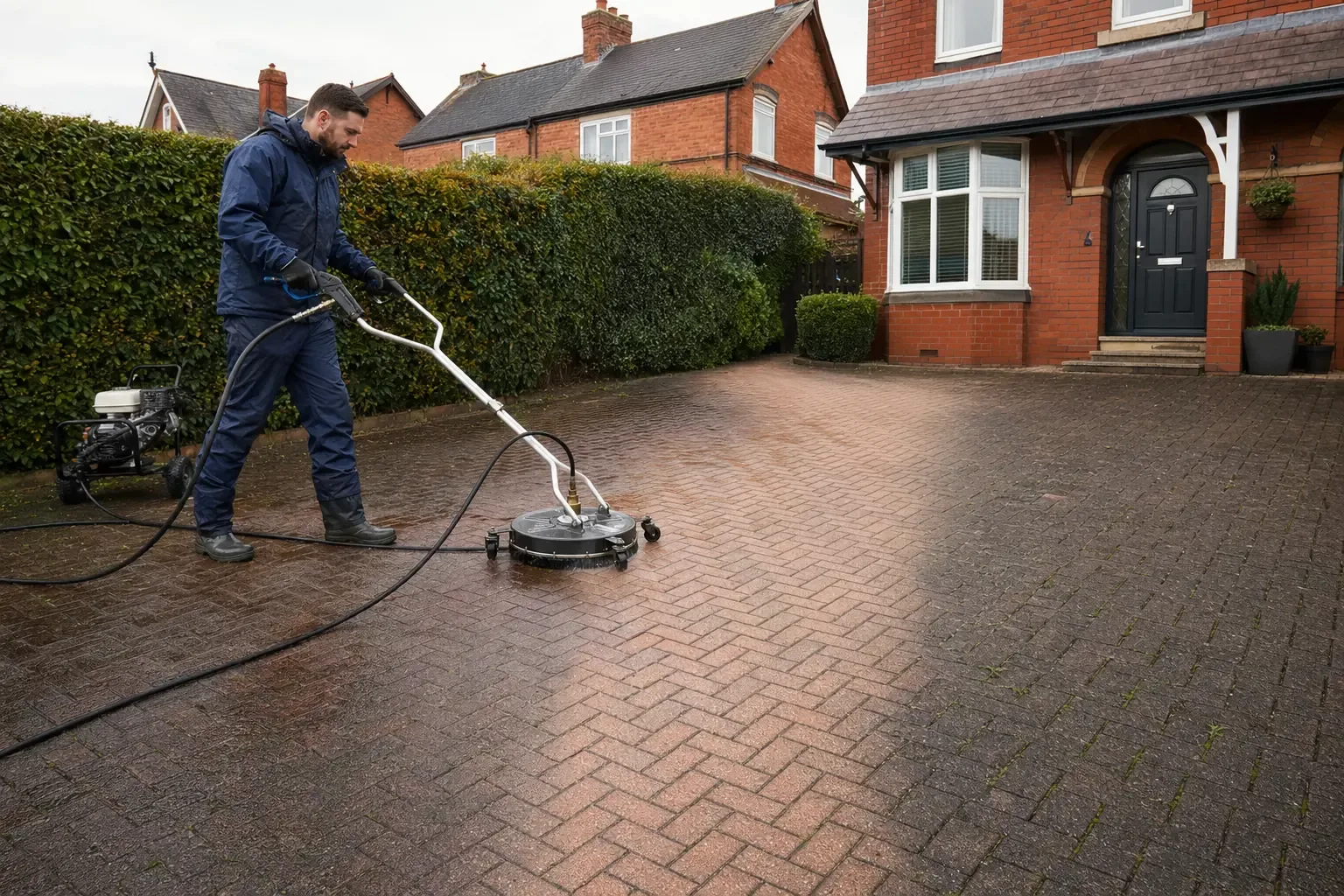
- Rotary clean, then detail. A flat surface cleaner covers the open area at an even height and speed, which is what stops zebra stripes. A lance handles edges, kerbs, steps and the awkward cuts around a manhole.
- Rinse and remove the waste. The drive is rinsed in one direction and the slurry is collected, not left to dry into a grey film or pushed onto a neighbour's frontage.
- Re-sand, then seal only if dry. Kiln dried sand goes back into the joints once the paving has dried out. Sealing, if you chose it, happens on a separate dry day.
When cleaning is not worth paying for
There are jobs we talk people out of. They look like this.
- The driveway is failing, not dirty. Sunken tracks, rocking blocks or a collapsed edging course are only made more obvious by a clean. Put the money towards relaying instead.
- It was laid under a year ago. The paving has not weathered yet and the jointing sand is still bedding in.
- It is a light green film on the north-facing half and it was cleaned last spring. A hard surface biocide watered on with a can will clear that for the price of a bottle.
- Grey oxidised tarmac. Cleaning removes what grows on it but does not restore the colour. Paying full price expecting black tarmac ends badly.
- You want it sealed next week and it is midwinter. The paving will not dry through. Book the sealing for spring and have the clean done whenever suits.
Getting a real number for your driveway
Measure it, note the surface, photograph the worst corner, then get two or three written quotes and compare like for like. If you want ours, we have been cleaning drives across Cardiff, Barry, Newport and the rest of South Wales since 2019. Call 07576 128903 or email Liamdunn2406@outlook.com with the size and the surface. The phone is answered seven days a week, 7:00 to 21:30.