What a lance actually does to a rendered wall
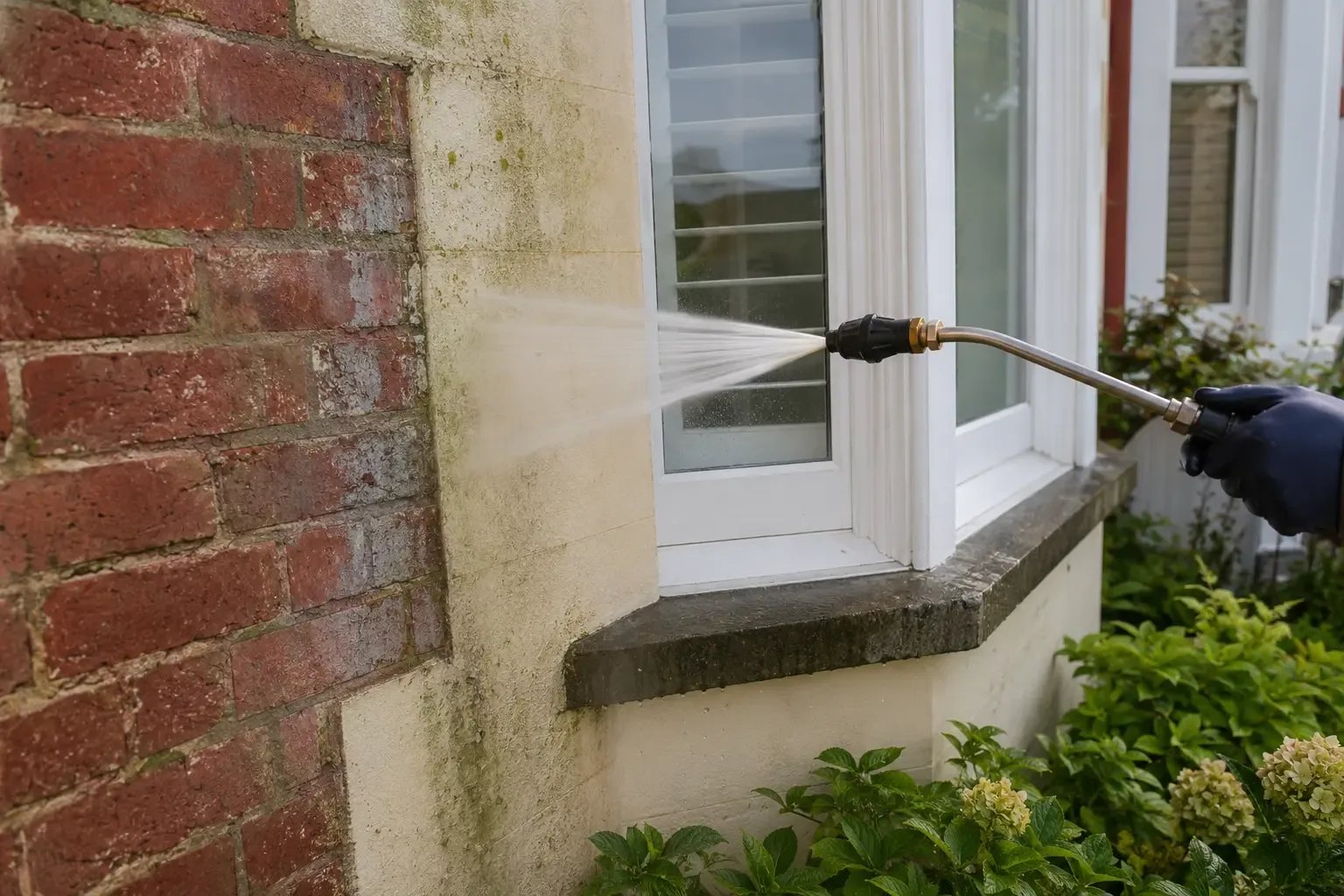
A domestic electric washer puts out around 1,500 to 2,200 psi at the nozzle. A petrol machine runs at 3,000 psi and above. Render is built to shed rain running down a vertical face, not to take a concentrated jet held 100mm away. At that distance a 15 degree nozzle is a cutting tool.
What goes first is the binder at the surface. Every render is aggregate held together by cement, lime, acrylic or silicone resin. The jet erodes that binder, the aggregate loses its grip, and you are left with an open, thirsty face that holds dirt better than it did before. Fit a turbo nozzle and it takes seconds.
K Rend and silicone thin coat take the worst of it
Thin coat silicone covers most of the Cardiff housing built since the mid 2000s, and it is what we find on the newer closes around Lisvane, Llanishen and Radyr. A basecoat of roughly 6 to 10mm with a glass fibre mesh bedded into it goes over the blockwork, then a topcoat of only 1.5 to 3mm carries the colour and the texture. There is no paint layer and no separate skin to lose. Take material off the face and you are taking the finish itself.
That is why it cannot be touched in afterwards. Render is mixed in batches, the batch on your house has weathered through several Welsh winters, and fresh material never matches it. On a visible elevation the honest repair is the whole elevation, corner to corner.
Monocouche, pebbledash and painted render
Monocouche is a single coat, usually 15 to 20mm, coloured right through and scraped back once it has gone off. The colour survives a jet. The texture does not, and in low sun you can read every pass the operator made across the wall.
Pebbledash and Tyrolean fail in their own ways. Pebbledash holds spar chippings mechanically in a wet bedding coat, so pressure knocks them straight out and leaves a heap of stone and sand at the base of the wall. Tyrolean is a brittle flicked coating with an open, peaked texture, and a jet flattens the peaks and takes patches off the backing. Either way, once an area is bald it stays bald. Both finishes are all over the 1930s semis in Whitchurch, Rhiwbina and Llanishen.
Painted render is the one people misjudge most. Masonry paint fails at its weakest edge, so a jet lifts it in sheets around cracks, beads and window reveals, then stops at a hard line everywhere else. You cannot spot repair that. A clean you hoped would cost a few hundred pounds becomes a full repaint.
The damage you do not see on the day
Surface damage is at least honest about itself. The expensive failure is water. A render skin has joints all through it: bellcast beads along the bottom edge and around openings, movement joints, hairline cracks, mastic that has gone hard and shrunk back. Rain runs past all of that. A pressure washer drives water straight through it.
Behind the render, water does not drain away, it sits. Cardiff gives it every chance to stay there, because a wall facing the south-westerlies off the Bristol Channel rarely dries out between one band of rain and the next. On a cold night the trapped water freezes and pushes the coat off its backing. Six months later you tap the wall and a patch sounds hollow. That is a blown section and it will come away in time. You may also get white efflorescence bleeding through the face, or rust staining where water has reached a steel bead or the metal lath in an older render. None of it showed on the day.
Striping is permanent
Wherever the lance paused or overlapped, more material came off, so you finish up with pale bands and fan shaped arcs across the lower two metres of the wall. It is erosion, not staining, so nothing washes it out. Cleaning again only makes it clearer, because the eroded bands green up at a different rate to the rest of the face. The ways out are a re-render, a masonry paint system over the top, or living with it.
How to tell if a wall has been jet washed before
- Pale bands or fan shaped arcs across the lower wall, fading out above head height
- Aggregate that looks more open and feels sharper than the render round the back of the house
- A line of sand or spar chippings along the base of the wall or on the drive
- Paint lifted in sheets around beads, cracks and reveals rather than worn evenly
- A hollow note when you tap near the bottom edge or under the sills
- Green regrowth returning faster on the washed elevation than on an untouched one
The repair costs many times what the cleaning does
Render cleaning on a Cardiff house usually lands somewhere around £250 to £500. That is indicative, it covers a whole property rather than one wall, and it moves with the render area, the number of elevations, the access round the back and how established the growth is. It is not a quote for your house.
Re-rendering is a different order of money. Silicone thin coat over a sound backing is priced by the square metre, generally in the region of £45 to £90 fitted, and one elevation of an ordinary semi is 40 to 60 square metres before anyone has costed the scaffold. Put it another way: a single damaged elevation costs more than having the whole house soft washed every three years for a decade. We do not re-render, so treat those figures as a ballpark and get two or three quotes from rendering contractors.
Can pressure washing damage render at a low setting?
It can, and the setting is not the whole story. Distance does as much as pressure. The same machine at 100mm does several times the harm it does at 600mm, and nobody holds a lance at a steady distance for an hour from the top of a ladder. Even on a low setting you are pushing water uphill into joints that only ever expected rain running down. There is also nothing to gain by it. Pressure takes off what you can see and leaves the roots alive in the surface, so the wall greens up within a season on a rougher face.
How render should be cleaned instead
- Work out what the wall is. Ten minutes at the wall tells you whether it is thin coat silicone, monocouche, pebbledash, Tyrolean or painted render, and each of them behaves differently under a chemical. The same look round finds the cracks, failed mastic and missing beads that decide whether wet cleaning is safe at all.
- Deal with the water path first. If the black streaks run from under the sills, off a gutter joint or a satellite bracket, that is drainage rather than dirt. Clean without sorting the cause and the stain comes back in the same lines within a year, usually by the first wet autumn.
- Protect the ground and the openings. Borders get a soak with clean water and then sheeting, downpipe outlets are covered or diverted away from ponds and vegetable beds, windows and doors are checked shut, cars moved off the drive. Watering the planting matters more than covering it, because a wet root zone dilutes anything that reaches it.
- Apply a biocide at soft wash pressure. A soft wash system runs at roughly 100 to 150 psi, nearer a garden hose than a pressure washer, so the chemical does the work and the machine only delivers it. We use a hypochlorite based mix on most render, and a quaternary biocide where planting, a pond or a delicate coating makes bleach the wrong call. It goes on bottom to top so nothing runs dry and streaks, off ground-based poles rather than a ladder leaned on the finish.
- Let it dwell, then rinse gently. Contact time is what kills algae, mould and the fungal partner in lichen right through, instead of bleaching the top of it and leaving the rest alive. A low pressure rinse then lifts the dead growth. Heavy lichen gets a second application rather than a harder jet, and the wall carries on clearing for two to three weeks after we have packed up.
When cleaning the render is not worth it
Some walls are better left alone, at least for this year.
- The render is already cracked or blown. Repair it first. Washing a wall that is coming away is money spent twice.
- The masonry paint is flaking. Cleaning takes more off, and the real job is a repaint.
- There is damp showing inside. Cleaning the outside will not touch it. Find the cause first.
- The stain is one narrow streak off a leaking gutter joint. Fix the joint and Cardiff rain will usually fade it for nothing.
- It is a light film on a south facing wall you had done two years ago. Book it with the gutters next spring and pay for one visit, not two.
- You are re-rendering or overcladding within the year. No sense cleaning a wall that is about to be covered.
If your render has already been pressure washed
Some of it can be recovered. A good deal of what looks like damage on a jet washed wall is fresh algae that has grown into the roughened surface, and a soft wash with proper dwell time brings much of that back. The erosion underneath will not come back. If a contractor did the work and you have not paid yet, photograph the wall square on in daylight, next to an elevation they did not touch, and put it to them in writing.
Send a photo of the worst elevation to Liamdunn2406@outlook.com or ring 07576 128903 and we will tell you what you are looking at and whether it is worth cleaning. We have been cleaning render across Cardiff, Barry and Newport since 2019, seven days a week, 7:00 to 21:30.