
H
Great company come out gave a good price and done the job straight away highly reccomend chris great guy
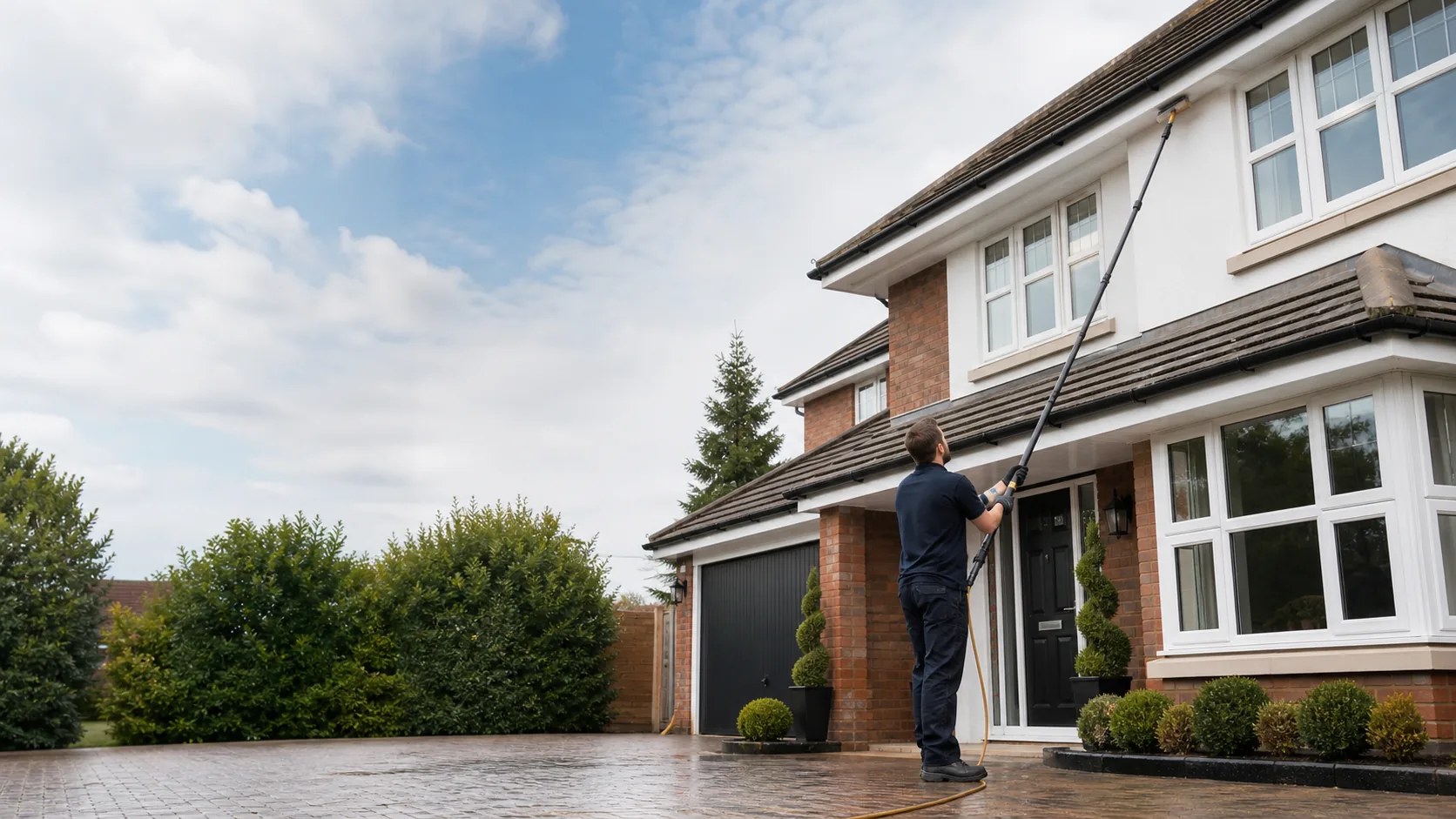
Fascia and soffit cleaning in Cardiff is the job most homeowners leave longest, because the change happens slowly enough that you stop noticing it. The white plastic under your roofline turns green on the shaded elevations and a greasy grey-black on the road side. We clean it from the ground with pure water, soft brushes and no bleach.
Step 1 of 3 · no obligation, reply the same day
The same care and clear communication, whether it is a single path or a whole house.
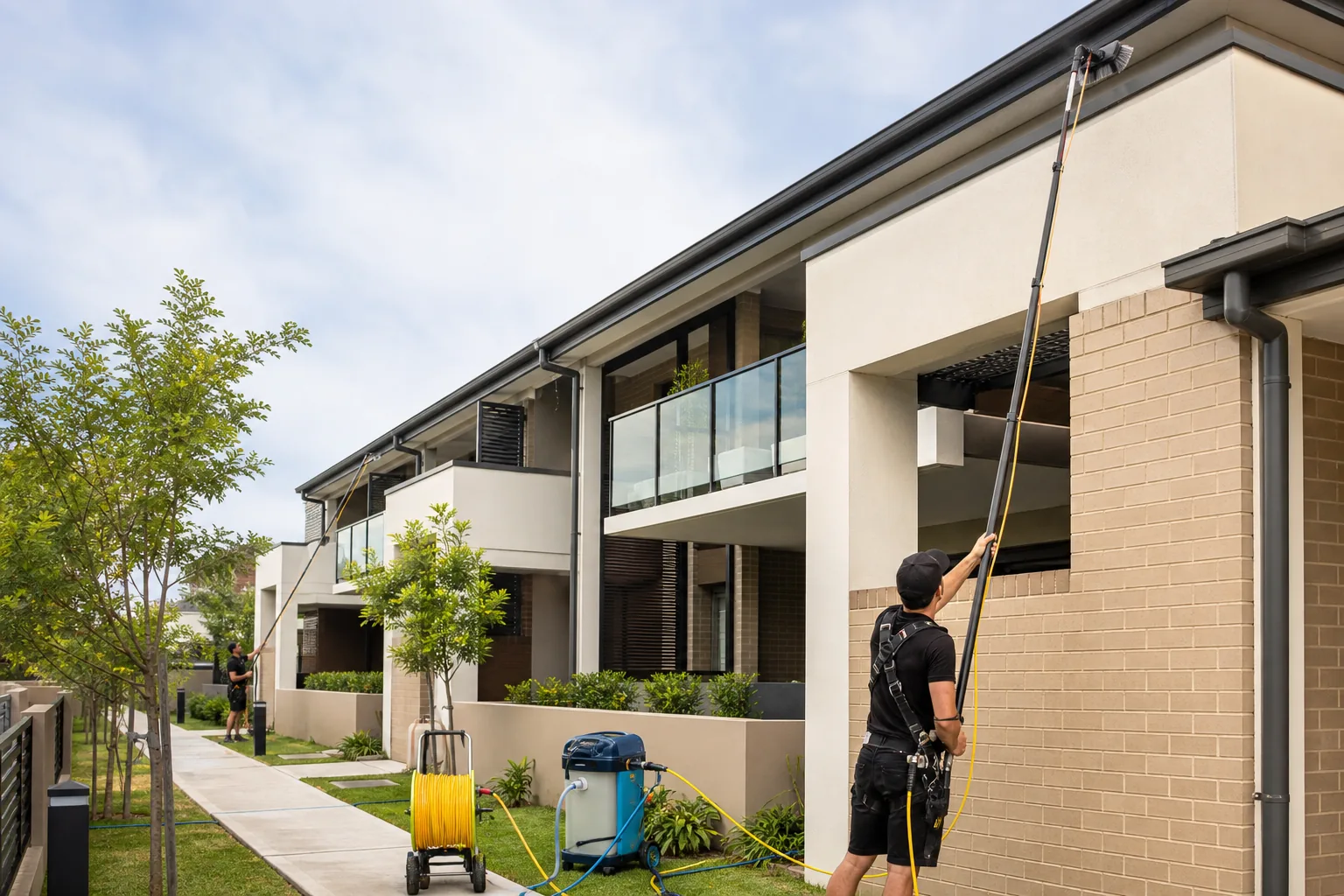
The roofline is more than the board you see from the pavement. On a standard Cardiff semi there is usually 30 to 40 metres of plastic once you count the soffit as well as the fascia and go round the back, and the parts holding the most dirt are the ones nobody looks at. We clean the whole run: front, back, sides and gable ends.
Two problems land on the same piece of plastic. The green is algae, a living film feeding on damp and airborne organic dust. It takes hold fastest on north-facing and shaded elevations, under overhanging trees, and round the back where the sun never fully dries the board. The mature garden suburbs get it worst, Penylan, Cyncoed, Lisvane and Rhiwbina especially, because the tree cover that makes those streets pleasant also keeps the roofline wet. Rain does not wash it off. Rain is what feeds it.
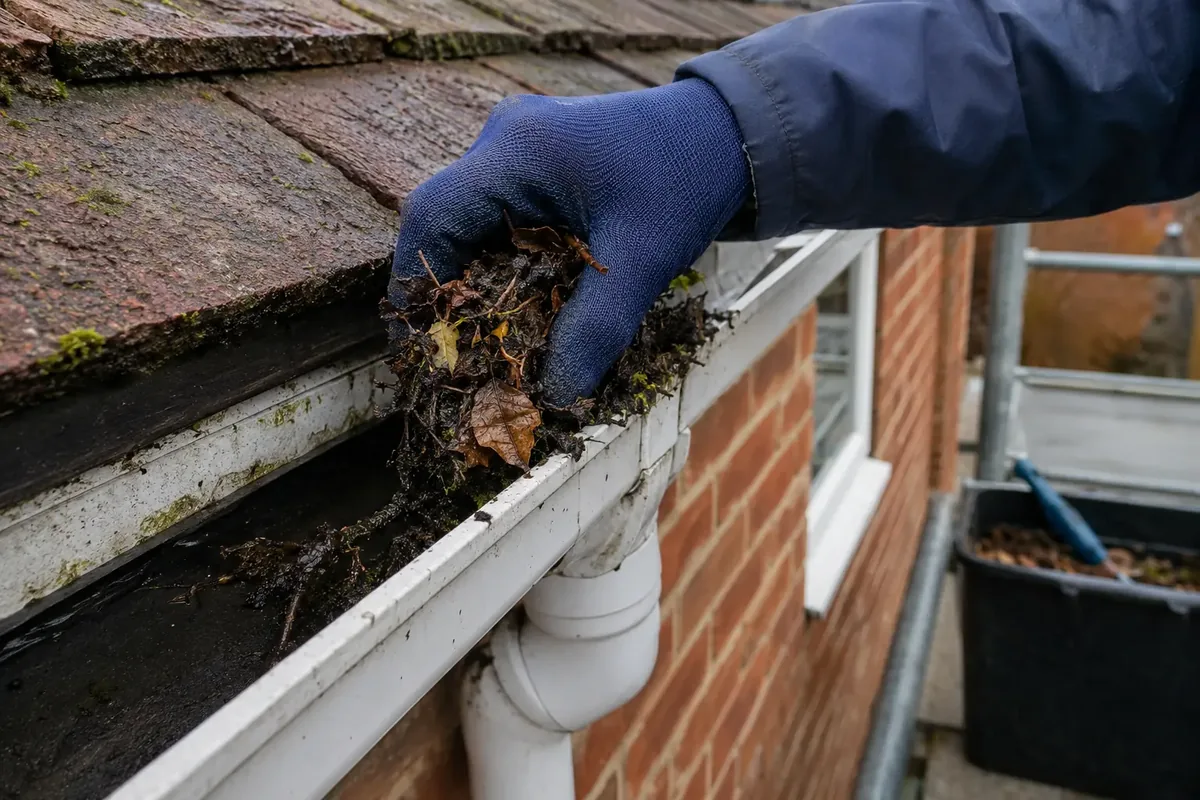
The grey-black film is traffic soot: diesel particulates, brake dust and tyre rubber bound into a greasy layer that keys into plastic and will not shift with a sponge. Houses on Newport Road, Cowbridge Road East, Western Avenue and the A470 run into town wear it heaviest. Dark stripes running down the fascia below a gutter joint are something else again. That is dirty overflow water, and it means the guttering needs clearing as well.
Household bleach on a cloth looks like it works. It kills the top of the growth and bleaches the stain pale, but the dead film stays on the board, so the green is back within a couple of months. It does nothing at all to oily traffic film. Whatever runs off the board then goes down your render, your brickwork and your planting, and we have seen walls left streaked for good that way.
The scourer does the lasting damage. uPVC leaves the factory with a thin glossy skin, and that skin is the only thing keeping dirt on the surface instead of in it. Green scourers, wire wool, abrasive cream cleaners and melamine foam sponges all take it off. What is left is a matte, finely scratched surface that holds dirt in every scratch and greens up faster than it did before. Washing will not bring the gloss back. From there it is a restoration job, or a replacement job.
A lance pointed up at a fascia forces water behind the board and into the soffit void, up under the eaves felt and into the loft. It blows sealant out of joints, pops clip-on trims loose, blasts the slots out of vented soffits, and splits boards that have gone brittle after twenty summers of ultraviolet. We own plenty of pressure washers. We just never point one at a roofline.
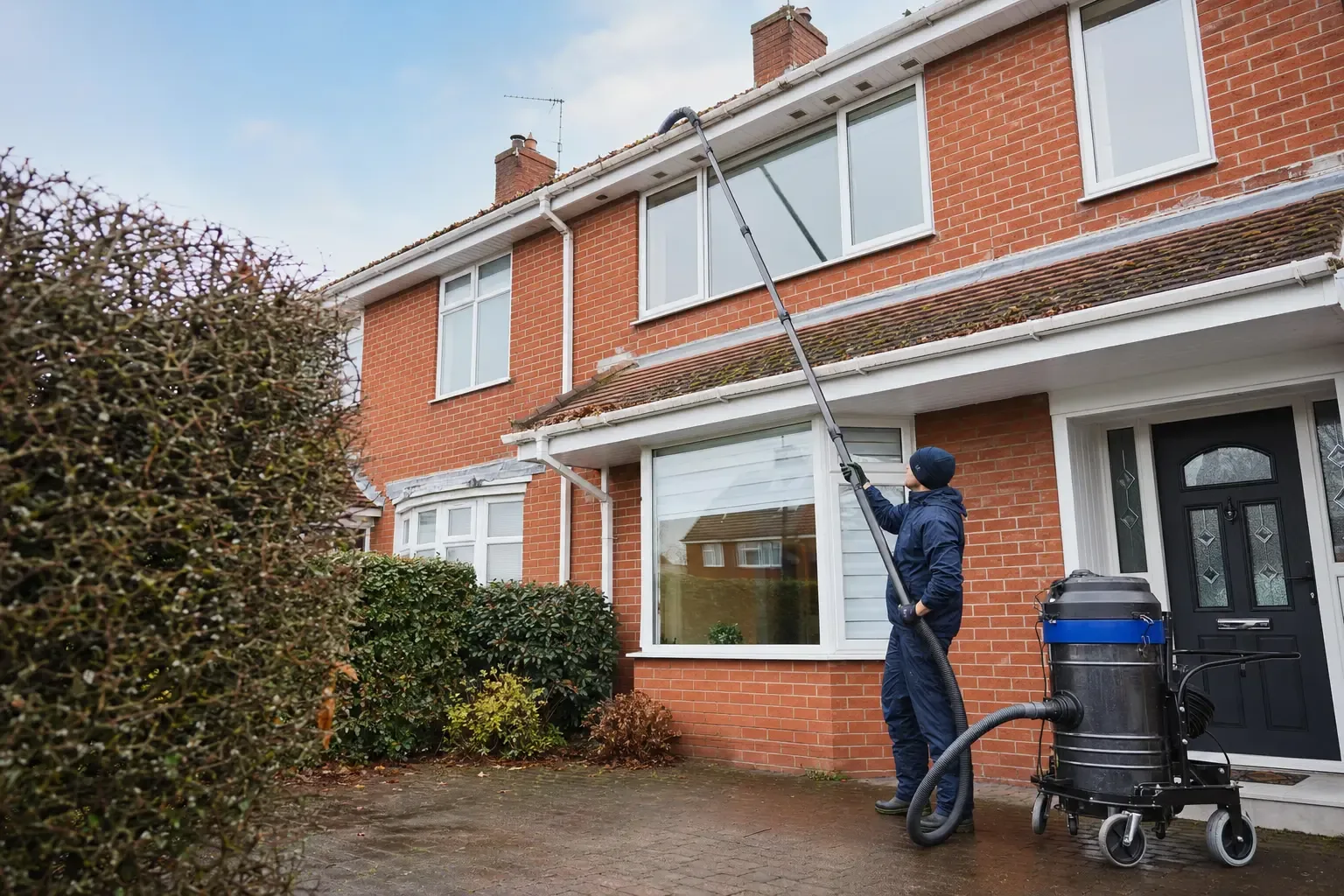
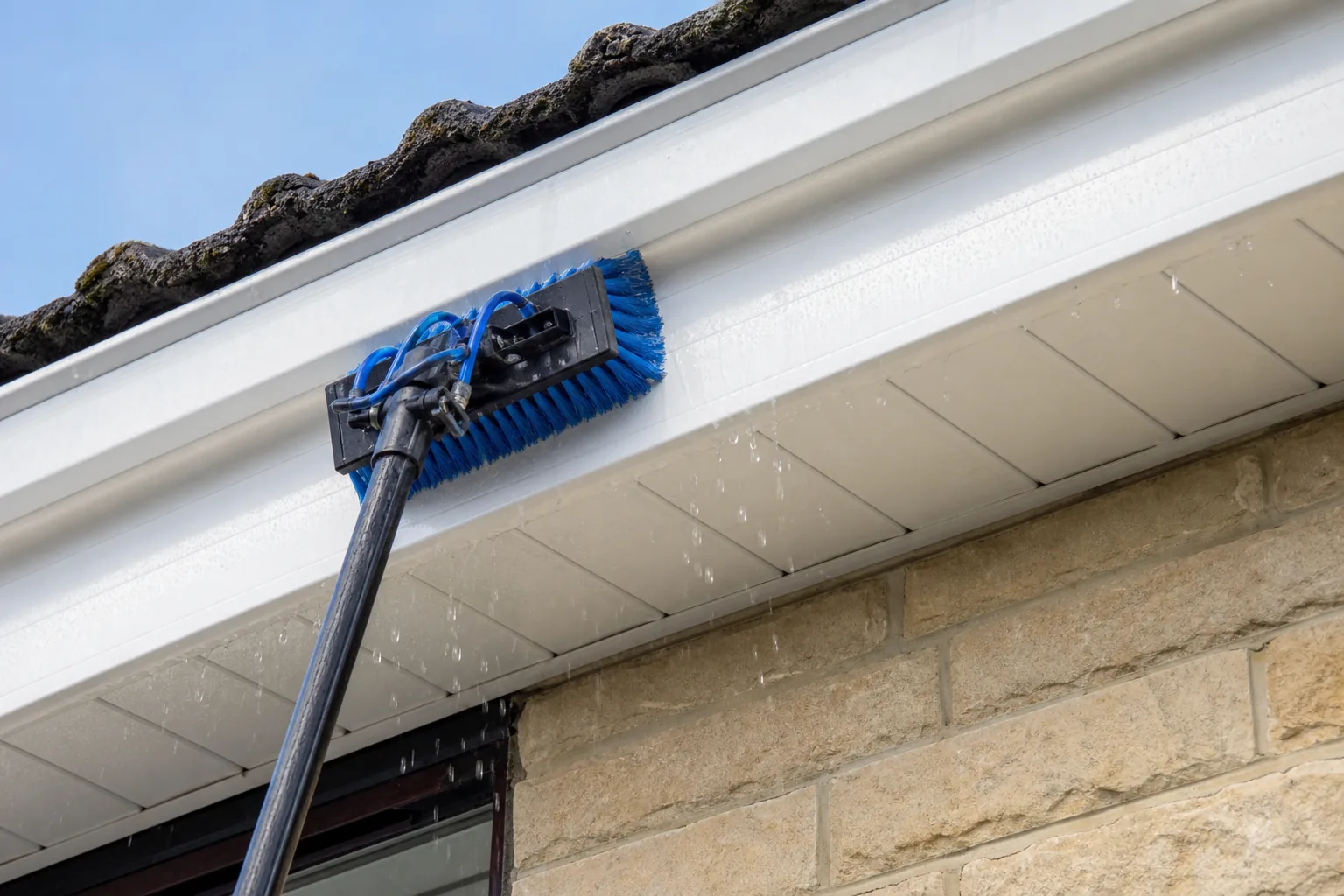
Everything above ground floor level is cleaned with a water-fed pole. Cardiff mains water is soft by UK standards, which helps, but soft is not pure, and plastic washed with it straight off the tap dries spotted. So it runs through sediment and carbon filters, then a reverse osmosis membrane, then a de-ionising resin vessel, until the TDS meter reads zero dissolved solids. Pure water is chemically hungry. It lifts dirt off the surface, holds it in suspension, and dries without a spot or a streak, because there is nothing left in it to dry on.
The head is a soft filament brush on a carbon fibre pole, long enough to take a three storey roofline from the ground. No ladder leaning on your guttering, no scaffold, nobody walking across your roof tiles. It also means we can reach over a conservatory or a back extension without trampling the borders to get there.
Light green comes off with brush and pure water alone. Heavier traffic film gets a pre-treatment made for uPVC, left to dwell so it can break the grease down before we agitate it. Where growth is thick we use a soft wash biocide, which kills the algae outright, spores included, rather than taking the visible film off and leaving the rest to regrow. That is what makes the clean last.
Rub an old fascia with your finger. If it comes away white, the board is oxidised and no amount of washing will fix it. Ultraviolet breaks down the surface of the plastic over fifteen or twenty years, the additives that hold the colour migrate out, and a dead chalky layer is left sitting on top. The board goes matte, then a yellowed grey, and rain drags the chalk down the wall in streaks.
Restoration is a different job to a wash. The dead layer is cut back with a compound made for uPVC, worked by hand or with a slow-speed polisher, then a restorer brings the colour back and leaves a protective film over it. It is close range, hands-on work, done off a ladder or a tower rather than a pole, and we price it separately.
Restoration does not save every board, and we will tell you straight when it will not. Painted boards, cracked or crazed boards, and foil woodgrain boards that have lost their foil are past restoring. Where it does work, the finish comes back close to new for a fraction of what a full replacement roofline costs.
Roofline cleaning and gutter clearing need the same access, the same visit and largely the same kit, which is why most people book the two together. It is also the right order of work, since blocked guttering is usually the reason a fascia is streaked in the first place. Doing both on one visit costs less than bringing us out twice.
A three-bed terrace or semi, roofline only, is normally 60 to 90 minutes. A detached house with a conservatory, a back extension and a gable end either side is closer to half a day. The price follows total metres of roofline, the height, how tight the access is round the back, how many years it has been left, vented soffits against solid ones, light green against bonded traffic film, and whether guttering or restoration goes on the same visit. You get a fixed figure before we start, not a rate per hour.
We work out of a unit in Cardiff, so most of the city is a short run for us. Roofline work goes out regularly to Roath, Penylan, Cyncoed, Lisvane, Llanishen, Whitchurch, Rhiwbina, Radyr, Llandaff, Canton, Pontcanna, Grangetown, Splott, Rumney, Llanrumney and Cathays, and we cover Barry, Newport and the rest of South Wales.
We have been cleaning exteriors around Cardiff since 2019, and our Google rating is 5.0 from five reviews, all of them five-star. Phone or text 07576 128903, or email Liamdunn2406@outlook.com with a couple of photos of your roofline, and we will come back with a price. Someone answers seven days a week, 7:00 to 21:30.
There is no single figure, because the price follows the metres of roofline and the access rather than the number of bedrooms. A small terrace with a clear front and back sits at the cheap end. A detached house with gable ends, a conservatory to reach over and ten years of traffic film costs considerably more. Vented soffits take longer than solid ones, and uPVC restoration is priced on top of a wash rather than included in it. Booking the guttering on the same visit is always cheaper than two separate visits. We give you a fixed price before any work starts.
A standard three-bed terrace or semi, covering fascias, soffits, bargeboards and downpipes, usually takes 60 to 90 minutes. Where there is more roofline than that, or where we are reaching over a conservatory and a back extension, allow half a day. Add gutter clearing and that is another 30 to 60 minutes depending on how blocked they are. uPVC restoration is the exception. It is hands-on work at close quarters and a full roofline can take a day or more, which is why it is always priced as a separate job.
No. The brush is soft filament, the flow of water carries the dirt away rather than the bristles grinding it along the surface, and the pressure involved is nowhere near enough to mark plastic. The things that genuinely damage uPVC are the ones people reach for at home: green scourers, wire wool, abrasive cream cleaners, melamine foam sponges, and a pressure washer lance held up at the roofline. Those either strip the factory gloss or force water in behind the boards. Our method exists precisely because those shortcuts leave damage you cannot wash out again.
On most Cardiff houses a proper clean holds for one to two years. Where we have used a soft wash biocide the growth is killed through rather than skimmed off the top, so the green takes noticeably longer to come back than it does after a plain rinse. What shortens it is shade, overhanging trees, a north-facing elevation, and blocked guttering that keeps overflowing down the same board. Frontages on the busy routes into town pick traffic film back up faster than quiet streets do. Plenty of people settle into a clean every eighteen months or so.
It helps if you are there at the start so we can agree exactly what is included and check the access round the back, but you do not have to stay. Plenty of people leave the side gate open and come home to a finished job. What we do need is an outside tap we can connect to, or room to park the van close enough to run a hose, windows closed, and cars moved off the area we are working over. If you would rather be there for the final walk round, say so when you book and we will time the visit around you.
Pure water on its own is harmless to planting, which is one of the reasons we do not clean rooflines with bleach. Where a pre-treatment or a biocide is needed we keep it on the plastic, cover or wet down anything sensitive underneath, and rinse the wall and the beds off afterwards. Debris pulled out of the guttering is bagged and taken away rather than flushed into your drains. If there is something you are particularly protective of, a new border, a pond, freshly painted render, point it out before we start.
Any month, honestly. The work is done from the ground and the surfaces dry within the hour, so it does not depend on a warm spell the way sealing or painting does. Autumn is the most popular slot, because the gutters need clearing anyway once the leaves have dropped and doing both at once makes sense. Spring is the other natural point, when a winter of damp air has left the shaded elevations green. The only thing that stops us is high wind, which is a pole safety issue rather than a cleaning one.
Often they can be saved. Chalkiness is oxidation, a dead layer left on the surface as ultraviolet breaks the plastic down, and it can be cut back and resealed with products made for uPVC. The result comes back close to new for a fraction of the cost of a replacement roofline. Not every board is a candidate, mind. Painted boards, cracked or crazed boards, and foil woodgrain boards that have lost their foil are past saving. We will look at yours and tell you honestly which category it falls into before pricing anything.
Great company come out gave a good price and done the job straight away highly reccomend chris great guy

Very reliable, showed up on time to give a quote, and started work straight away! Wanted the back done after the front. Stunning work on my front driveway and porch with the power washer, simply removed all the algae on my walls too that the pressure washer team we had last year couldn't do.

Hard working and reliable pressure washing company! Completely transformed my paving stones and patio

Very happy with the service provided from pressure washing Cardiff, also very friendly and professional many thanks, Simon
What a good quality service have provided done a superb job of pressure washing my driveway + house. Many thanks, Shane
My husband and I are very happy with the work done at our house, to our gutters, our pool area and other concrete areas around our house. You were a pleasure to deal with and I will definitely use your services again!
Pressure Washing Cardiff did a fabulous job: our concrete driveway and retaining walls look like new! What a delight to have a tradesman visit who takes pride in his work and does a thorough job.
These guys are experts and were able to give us a great quote for a complete exterior makeover. Power washing, gutter cleaning, window cleaning as well as pressure washing for our patio and driveway. Thank you so much!!
Send a photo and a rough size and we will come back with a price, usually the same day.
20% off enquiries via WhatsApp