
H
Great company come out gave a good price and done the job straight away highly reccomend chris great guy
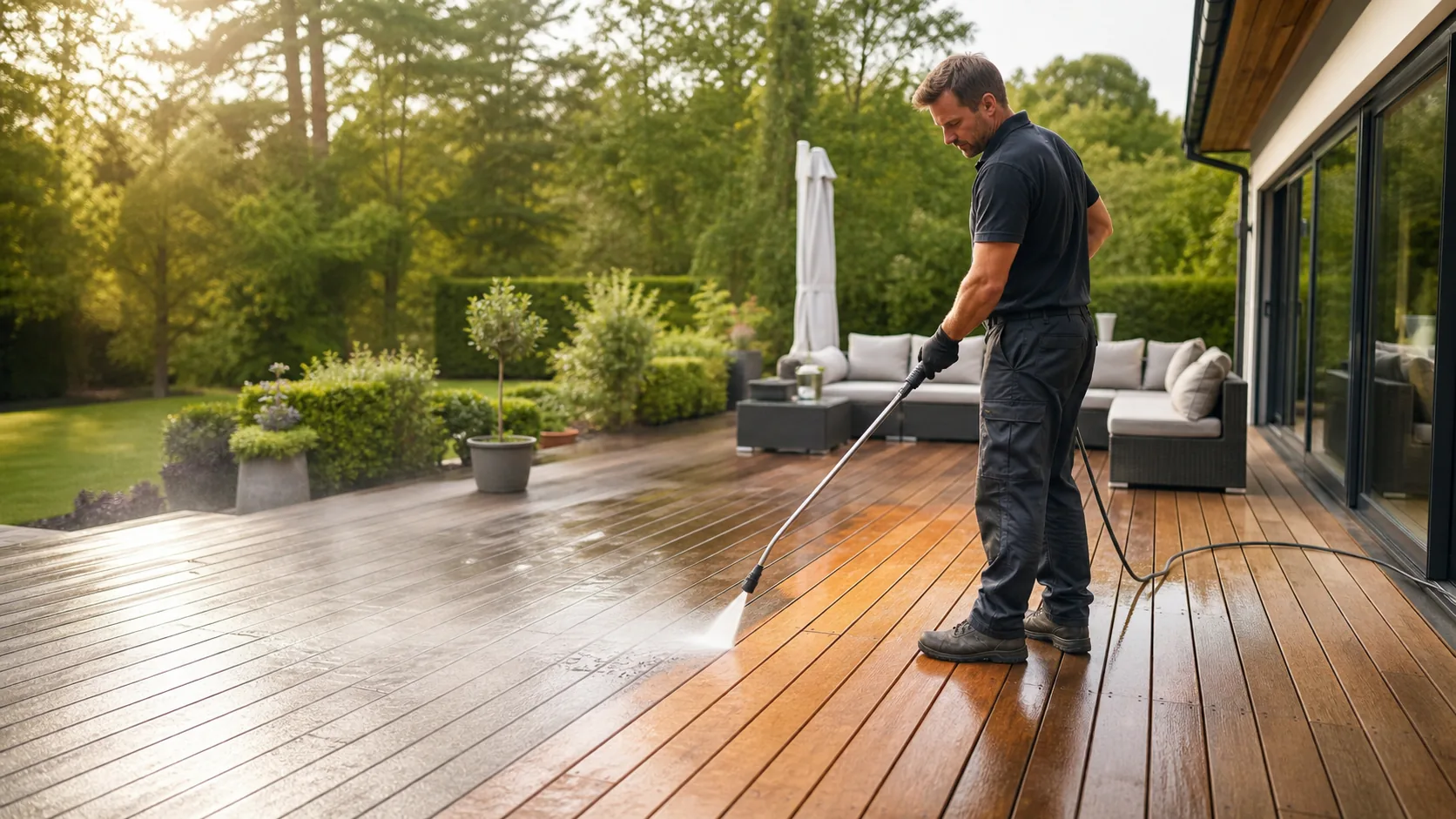
Decking cleaning in Cardiff is one of those jobs where the pressure setting matters more than the machine. A green, slippery softwood deck can be brought back in an afternoon, or it can be furred, stripped and left looking worse than it started. We clean decking and fence panels across Cardiff and South Wales, at pressures the timber can actually take.

Step 1 of 3 · no obligation, reply the same day
The same care and clear communication, whether it is a single path or a whole house.
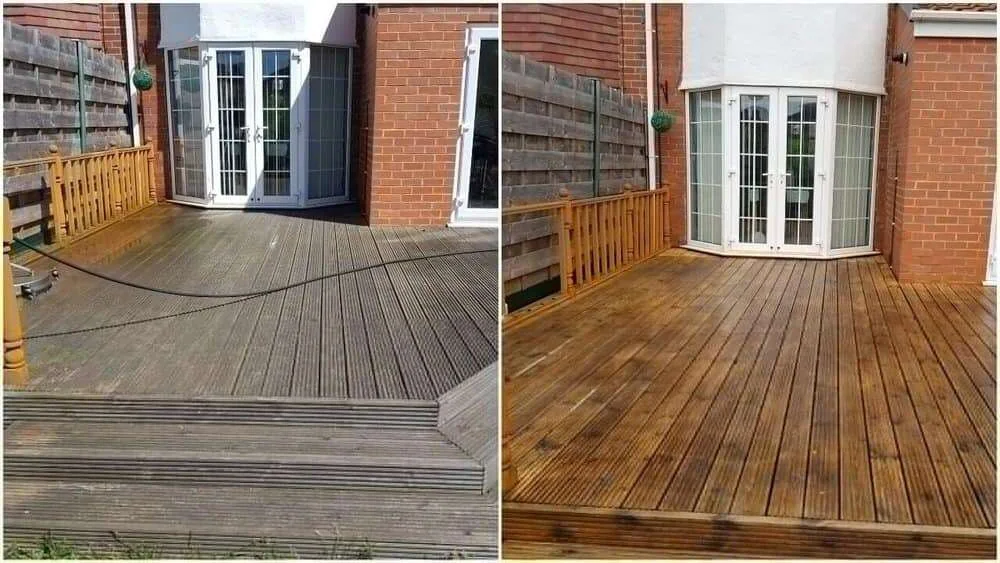
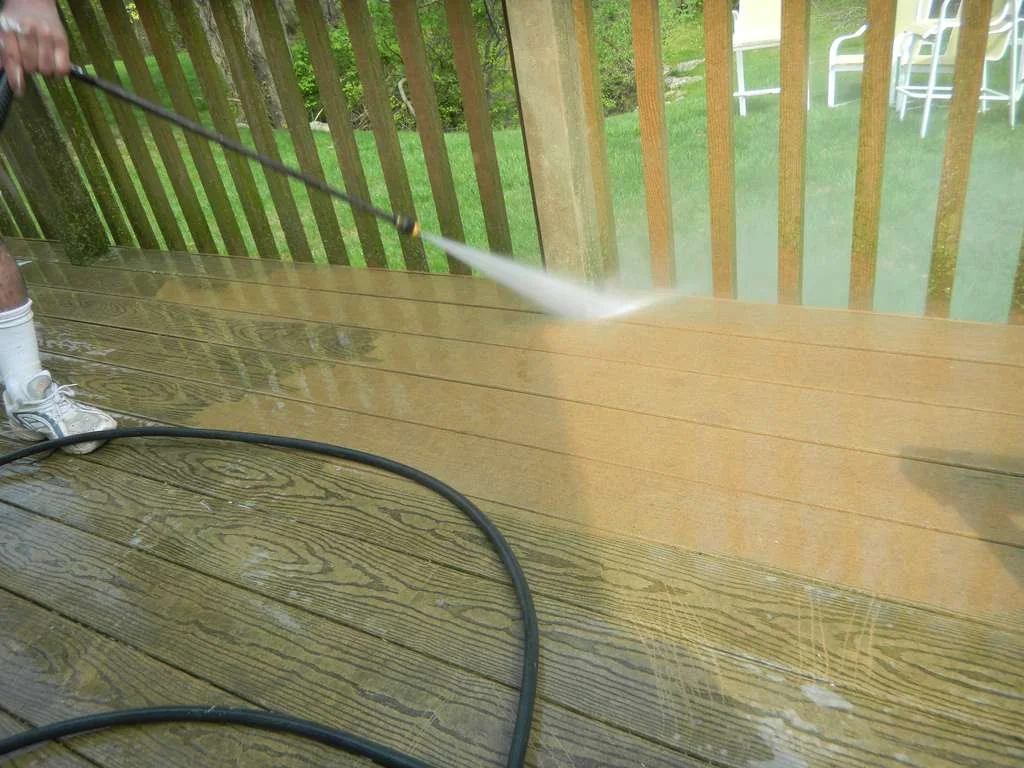
Decks here spend half the year damp. Cardiff takes more rain than most UK cities, and a garden deck in Roath or Penylan that sits in the shade of a fence, a shed or next door's conifers barely sees direct sun between November and March. Algae colonises the grain and holds water against the boards. Green film, black spotting and a soft slimy surface at the shaded end are the same problem at three different stages.
The slip risk is the part people underestimate. Wet algae on a smooth-faced deck board has roughly the grip of ice, and steps are the worst of it because the tread is short and you are usually carrying something. If you can draw a clean line through the surface with your shoe, the deck is overdue. Grooved boards are no safer than smooth ones, whatever they were sold as: the grooves hold water, growth and grit long after the rest of the board has dried.
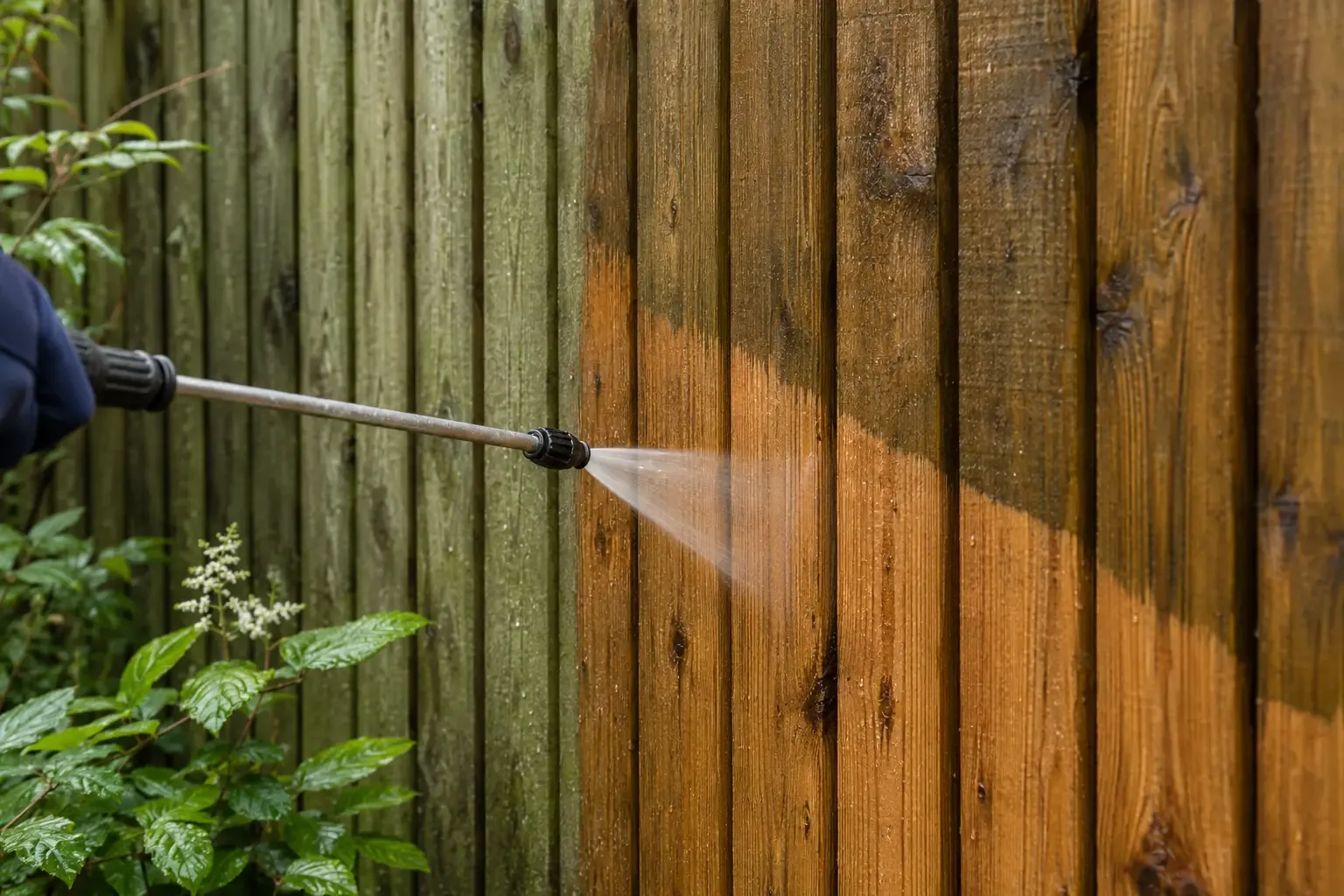
Softwood is soft, and a lance held too close does permanent damage in under a second. A narrow jet at full pressure tears out the softer growth between the harder grain lines and leaves the surface fibrous. That is furring, and no amount of washing brings it back. The board turns rough underfoot, splinters lift, and the opened grain holds far more water than it did before, so the deck goes green again faster than it used to.
It shows from the house as well. Held at an angle or moved unevenly, a jet leaves tiger stripes across the boards that only sanding will remove. On pressure-treated softwood the preservative is concentrated in the outer few millimetres, so blasting that layer off takes the rot protection with it. We work the other way round. An oxygen based deck cleaner goes on first and is left to dwell so the algae releases on its own, then a wide fan nozzle at low pressure is swept along the grain at a fixed distance. Strong hypochlorite stays off bare timber, because it bleaches the wood pale and roughens the fibres.
Most Cardiff back gardens have pressure-treated softwood decking, usually European redwood, and it is the least forgiving surface of the lot: absorbent, easily marked, and with the preservative only skin deep. Hardwood decks in balau or ipe are far tougher underfoot, but they weather to a silver grey that sits in the surface fibres, so washing alone will not bring the colour back without an oxalic acid brightener afterwards. We tell you which you have before we quote, because it decides how the finished deck will look, not just how clean it gets.
Composite is not maintenance free, whatever the brochure said. Uncapped boards are wood flour and plastic, and mould grows happily in the embossed grain. Capped boards resist that, but the cap scars, and once a pressure mark is in it, it stays. Manufacturers publish a maximum pressure and a minimum nozzle distance for a reason, and we stay inside both, using a soft brush, a composite safe cleaner and a low pressure rinse. No wire brushes and no rotary flat surface heads on a capped board.
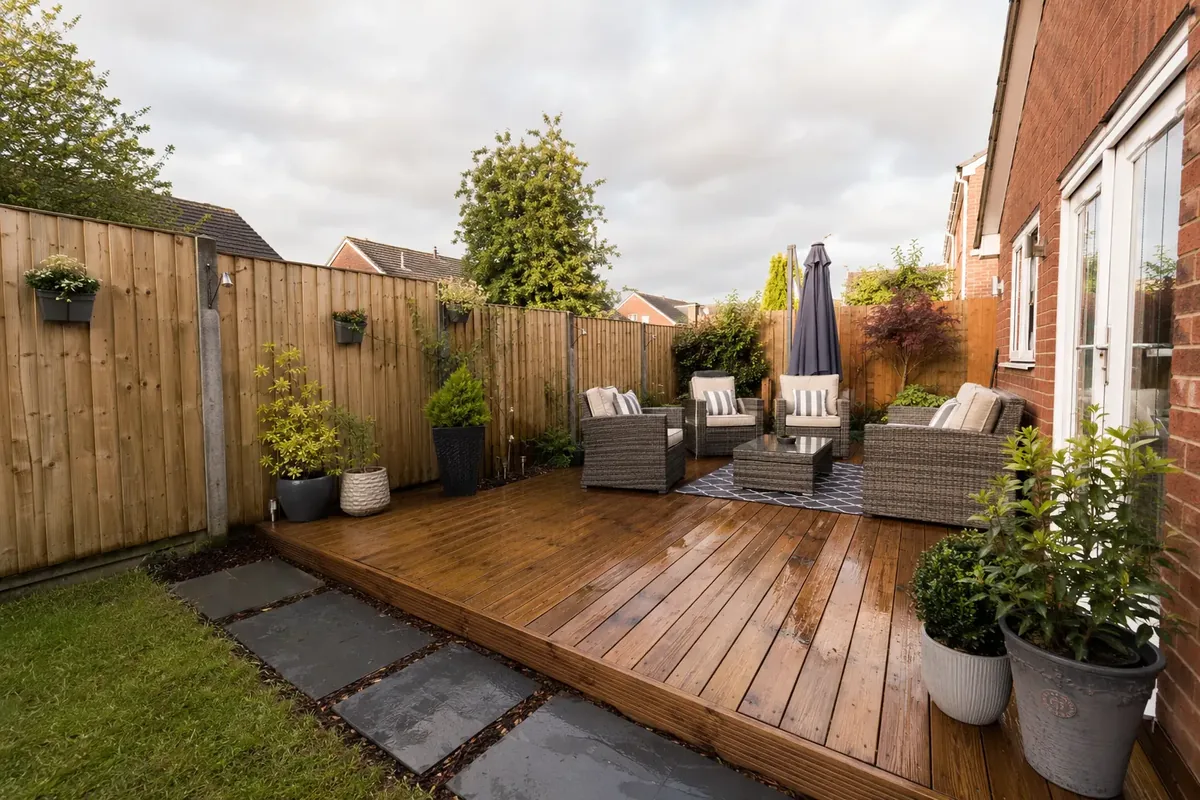
A fence takes the same weather as the deck, from both sides, with no foot traffic to wear the growth back. The panels that go worst are the ones with a hedge or a shrub border pushed up against them, where the timber never dries and the bottom 300mm of every board stays wet from October to March. You get green algae on the faces, black mould in the grain and orange lichen along the cap. Cleaning it off is not only cosmetic. Growth keeps moisture in the timber, and wet softwood in permanent contact with soil and planting is what rots feather-edge boards and gravel board tops out years early.
A fence panel is thinner than anything on your deck. Lap and feather-edge boards are only a few millimetres thick and they flex, so a jet a paving slab would shrug off punches straight through or lifts the panel out of its frame. Fence work is mostly treatment and rinse with the pressure right down. Concrete posts and gravel boards will take more. Timber posts often will not, and we test the base of each one before we start, because a rotten post is usually being held up by the panels either side of it.
We clean your side. The far side of a boundary fence belongs to a conversation with your neighbour rather than to us, so if you want both faces done we need them to agree first. Even on a one sided job we keep overspray down, and it is worth giving next door a knock so washing comes off the line and cushions come indoors.
Cleaning opens the timber up, which is what a finish wants and exactly why the next bit cannot be rushed. Oil applied to damp boards will not penetrate. It sits on the surface, dries patchy or milky and lifts within a season. Give the deck at least 48 hours of dry weather in summer, and longer in autumn, when boards here can hold moisture for most of a week. The test is simple: sprinkle water on a board, and if it soaks straight in the timber is ready.
There is a practical reason to clean before you refinish rather than after. Stain and oil bond to timber, not to the algae and grey surface dust sitting on top of it, so a finish rolled over a dirty deck lifts in sheets inside a year and then has to be stripped before anything else can happen. Cleaning also shows you what you actually have, since patchy old stain, split boards and soft spots only become obvious once the green is off. On softwood we would point you at a penetrating decking oil rather than a film-forming varnish, because film finishes on horizontal boards peel where the sun and the foot traffic hit them.
Most Cardiff decks are small, so this is one of the cheaper jobs we do. As indicative guidance, a straightforward 15 to 25 square metre softwood deck usually lands somewhere around £120 to £220, and fencing is normally priced by the panel or by the run rather than by area. Those are guide figures, not a quote. What moves the number is size and layout, how thick the growth is, whether old flaking stain has to come off, whether there are steps and balustrades, and how the garden is reached, because a terrace in Canton with no side access means every hose runs through the house.
Time on site follows the same logic. A single deck with surface algae is often 60 to 90 minutes of actual washing, plus setting up, dwell time and rinsing. Add a run of fence panels and you are into a half day. Failed stain that has to be stripped first is a different job, and we say so at the quote rather than on the day.
We have been cleaning exteriors around Cardiff since 2019 and our Google rating is 5.0 from five reviews. Decking and fencing fits alongside the rest of the round, so gardens in Whitchurch, Rhiwbina, Llanishen, Lisvane, Cyncoed and Llandaff are normal territory, as are Barry, Newport and the wider South Wales area. Call or message 07576 128903, or email Liamdunn2406@outlook.com. We answer seven days a week, 7:00 to 21:30, and quotes are free. A couple of photos and rough measurements are usually enough for us to price the work without coming out first.
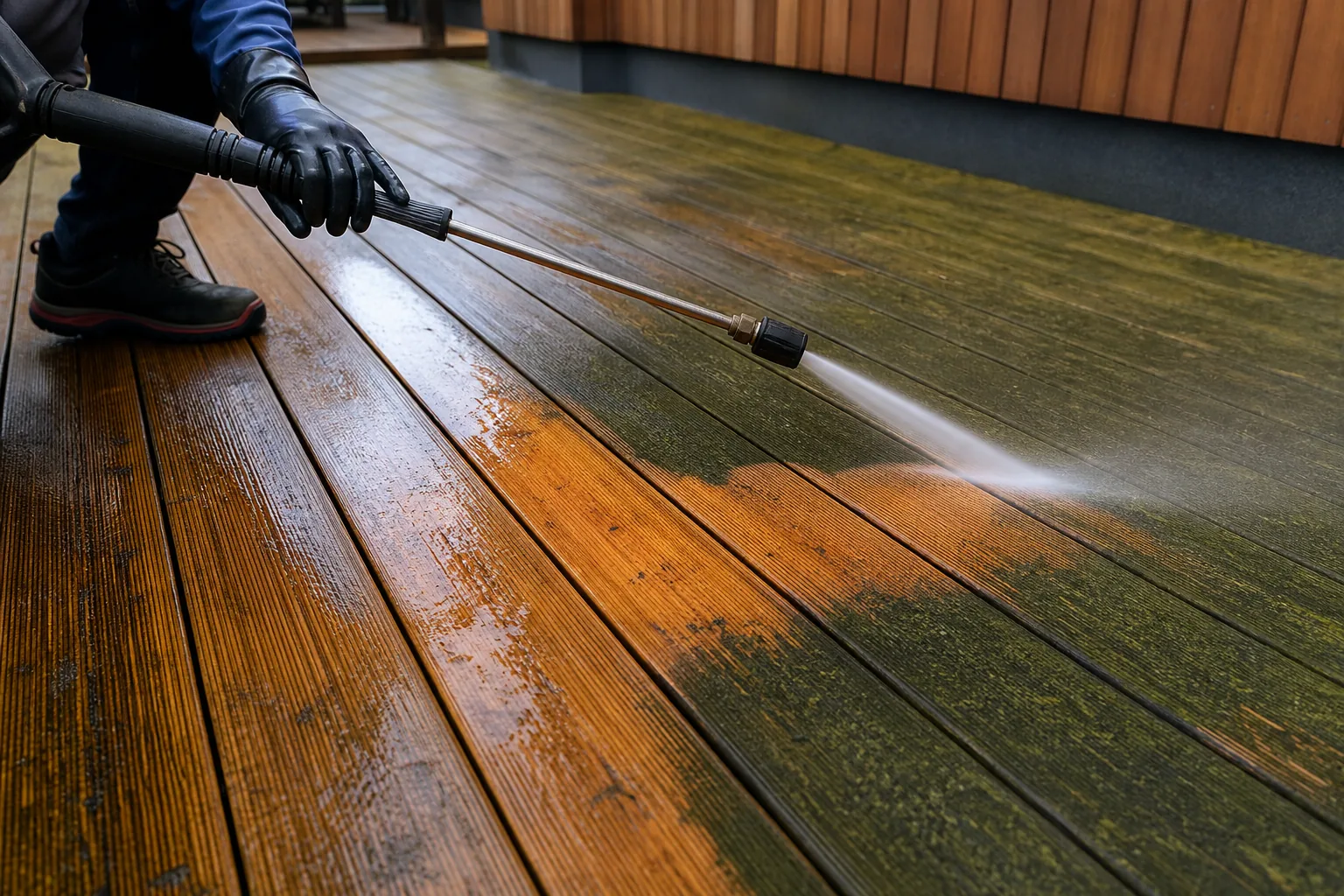
There is no fixed price because no two decks are the same, but as guidance a typical 15 to 25 square metre softwood deck usually falls somewhere around £120 to £220, and fencing tends to be priced by the panel. What pushes a job up is thick moss, old flaking stain that has to come off, plenty of steps and balustrade, awkward access through the house, and a fence run added on the same visit. Send a couple of photos with rough measurements and we can give you a realistic figure before we visit.
It can, and that is the whole reason to be fussy about who does it. Too much pressure on softwood tears the soft grain out and leaves the boards furred and splintery, and a jet held at the wrong angle leaves stripes that only sanding removes. On composite it scars the cap permanently. We avoid all of that by doing most of the work chemically: a cleaner is left to dwell so the growth releases, then a wide fan nozzle at low pressure is swept along the grain. Done that way the boards come up clean and the surface stays intact.
Most residential jobs are done in one visit. A single deck with surface algae is usually 60 to 90 minutes of washing once you add setting up, the dwell time for the cleaner and rinsing down, so roughly half a morning door to door. A deck plus a run of fence panels is normally a half day. Bigger raised decks with balustrade and steps, or timber carrying old failed stain, take longer because the detail work is by hand. We give you a time slot when we book and tell you if anything on site changes it.
On a sunny, open deck you will often get two summers before it starts to look tired. In a shaded Cardiff garden, north-facing or hemmed in by fences and planting, expect around a year before green starts creeping back. Timber that is oiled soon after cleaning holds off growth noticeably longer than bare boards, because water beads instead of soaking into the grain. Sweeping leaves off in autumn matters more than people think: a layer of wet leaf left all winter is what puts the black spotting back.
Not the same day. The timber has to dry right through or the finish will sit on the surface, dry patchy or milky and lift within a season. In warm dry summer weather 48 hours is usually enough. In spring or autumn give it three to five dry days, and do not bother at all in a wet week, because the boards will never get there. To check, flick a little water onto a board: if it beads, the wood is still holding moisture, and if it soaks straight in you are ready. On softwood use a penetrating decking oil rather than a film-forming varnish.
Not necessarily. We need access to the garden and to an outside tap, so if there is a side gate you can leave unlocked and a tap we can reach, you can be out at work. What helps is a quick conversation beforehand about anything we should know: a pond, a delicate border, decking lights, a loose board, or a fence you share with a neighbour. Most people are around at the start so we can walk the deck together and agree what will and will not come off, then leave us to it.
Borders next to a deck are watered before we start and sheeted while we work, then rinsed again afterwards, so nothing concentrates on the leaves. Ponds are covered and run-off is steered away from them, because water coming off the deck is the real risk to fish rather than the wash itself. Rinse water carrying cleaner does not go into a surface water drain, since those run to the river or the sea rather than to treatment. It goes to soakaway or to a foul drain. Tell us about a pond or a vegetable bed at the deck edge when you book and we will plan around it.
Spring and early autumn are the sweet spots. Spring takes the winter algae off before you start using the garden and usually leaves a dry enough window to oil afterwards. Early autumn clears the summer's dirt before the wet months set in, which is when growth really takes hold. High summer is fine and dries fastest, and it is the only time you can reliably count on boards being ready to oil within two days. We work through winter as well, but a deck cleaned in December will not take a finish until spring.
Great company come out gave a good price and done the job straight away highly reccomend chris great guy

Very reliable, showed up on time to give a quote, and started work straight away! Wanted the back done after the front. Stunning work on my front driveway and porch with the power washer, simply removed all the algae on my walls too that the pressure washer team we had last year couldn't do.

Hard working and reliable pressure washing company! Completely transformed my paving stones and patio

Very happy with the service provided from pressure washing Cardiff, also very friendly and professional many thanks, Simon
What a good quality service have provided done a superb job of pressure washing my driveway + house. Many thanks, Shane
My husband and I are very happy with the work done at our house, to our gutters, our pool area and other concrete areas around our house. You were a pleasure to deal with and I will definitely use your services again!
Pressure Washing Cardiff did a fabulous job: our concrete driveway and retaining walls look like new! What a delight to have a tradesman visit who takes pride in his work and does a thorough job.
These guys are experts and were able to give us a great quote for a complete exterior makeover. Power washing, gutter cleaning, window cleaning as well as pressure washing for our patio and driveway. Thank you so much!!
Send a photo and a rough size and we will come back with a price, usually the same day.
20% off enquiries via WhatsApp